When I think about fall symbols, I do not think of only orange leaves or pumpkins. Autumn has a whole visual language of its own: falling leaves can suggest change, acorns can represent growth and potential, harvest imagery can point to abundance, and the autumn equinox marks a natural transition in the year.
If you are looking for the meaning of fall symbols, this guide brings the most familiar symbols together and explains what they can represent, where they come from, and how people use them in everyday life, art, decoration, writing, and seasonal celebrations. You will also learn which meanings are widely recognized and which are more modern or tradition-specific.
What Are Fall Symbols?
Fall symbols are objects, colors, natural signs, foods, animals, or seasonal events commonly associated with autumn. They can represent ideas such as change, transition, harvest, abundance, preparation, maturity, warmth, gratitude, and letting go.
Some symbols have a direct connection to what happens in nature. Falling leaves, for example, are a visible part of seasonal change in many temperate regions. Other symbols come from agriculture, food traditions, cultural celebrations, literature, or modern autumn decoration.
There is not one universal dictionary in which every fall symbol has one fixed meaning. A symbol can carry different meanings depending on its cultural, religious, historical, or personal context.
Why Do Fall Symbols Matter?
Symbols make an abstract idea easier to see.
For example, saying that autumn represents change is an idea. Showing a golden leaf drifting from a tree gives that idea a physical image.
This is why fall imagery appears so often in:
- home décor
- greeting cards
- classroom projects
- seasonal photography
- poems and stories
- logos and graphics
- wedding themes
- social media posts
- tattoos and artwork
- autumn festivals
- Thanksgiving-related decorations
The same image can also communicate several ideas at once. A harvest basket may suggest food, abundance, hard work, gratitude, and the end of a growing season.
The Most Common Fall Symbols and Their Meanings
Many autumn symbols come directly from the natural world. Others developed through agriculture, food traditions, folklore, and seasonal customs.
Here are some of the most recognizable examples.
| Fall symbol | Common association | What it can represent |
| Falling leaves | Seasonal change | Change, transition, letting go |
| Autumn leaves | Fall foliage | Beauty, maturity, transformation |
| Maple leaf | Autumn landscape | Change, nature, seasonal beauty |
| Oak leaf | Woodland autumn | Strength, endurance, maturity |
| Acorn | Oak trees | Potential, growth, future |
| Pumpkin | Autumn harvest | Harvest, abundance, seasonal celebration |
| Apple | Harvest season | Harvest, knowledge, nourishment |
| Corn | Agriculture | Abundance, harvest, prosperity |
| Wheat | Harvest | Provision, abundance, nourishment |
| Hay bale | Farming | Agriculture, harvest, rural life |
| Pinecone | Woodland | Nature, resilience, preparation |
| Apple cider | Autumn food tradition | Warmth, comfort, seasonal gathering |
| Scarecrow | Farm fields | Agriculture, harvest, rural tradition |
| Cornucopia | Harvest imagery | Plenty, abundance, gratitude |
| Owl | Autumn woodland imagery | Wisdom, mystery, nighttime |
| Fox | Woodland imagery | Adaptability, cleverness, nature |
| Deer | Forest and fall scenes | Wild nature, gentleness, seasonal life |
| Pumpkin spice | Modern fall culture | Comfort, warmth, seasonal identity |
| Warm colors | Fall foliage | Coziness, maturity, change |
| Autumn equinox | Seasonal transition | Balance, transition, changing seasons |
The meanings in this table should be treated as common associations, not universal rules. Symbolic meaning changes across cultures and contexts.
Falling Leaves Symbolize Change and Letting Go
The falling leaf is probably one of the clearest visual symbols of autumn.
A leaf attached to a tree can suggest life, growth, and vitality. A leaf falling from the tree creates a very different image: a stage has ended and something new is approaching.
That makes falling leaves especially useful as symbols of:
- change
- transition
- letting go
- maturity
- the passage of time
- impermanence
- natural cycles
- new beginnings after an ending
There is also a real scientific process behind the imagery. As seasonal conditions change, many deciduous trees produce less chlorophyll. When the green chlorophyll fades, other pigments become more visible, producing yellow, orange, and red foliage.
Why Falling Leaves Have Such a Strong Meaning
The symbolism works because the physical event is easy to understand.
The leaf does not simply disappear. It changes color, separates from the tree, and becomes part of the ground.
That makes it a powerful image for writing about life transitions.
For example:
“Like the leaves in autumn, some things have to fall away before a new season can begin.”
The sentence works because the natural process gives a concrete image to an abstract emotional idea.
Autumn Leaves Represent Beauty, Transformation, and Time
Not every fall leaf needs to be shown falling.
A colorful autumn leaf can represent transformation because the leaf visibly changes before it leaves the tree.
Red, orange, yellow, gold, and brown foliage are therefore often associated with:
- transformation
- seasonal beauty
- maturity
- nostalgia
- change
- temporary beauty
- the passage of time
The science behind leaf color also makes this symbol more interesting than the common idea that frost simply “paints” the leaves. The U.S. Forest Service explains that changes in daylight and temperature contribute to the breakdown of chlorophyll, allowing other pigments to become visible.
What Different Leaf Colors Can Suggest
Color symbolism is not universal, but in modern autumn imagery these associations are common:
- Red: energy, warmth, intensity
- Orange: warmth, creativity, enthusiasm
- Yellow: brightness, optimism, sunlight
- Gold: richness, value, maturity
- Brown: earth, stability, aging, natural decay
These are interpretive associations rather than fixed meanings.
The Maple Leaf Represents Autumn and Natural Beauty
The maple leaf is strongly associated with fall because many maple species produce striking seasonal foliage.
In autumn artwork, a maple leaf can represent:
- seasonal change
- natural beauty
- forests
- cooler weather
- maturity
- the arrival of fall
The maple leaf is also an important national symbol of Canada, so its meaning can extend beyond autumn when it appears in a Canadian context.
That distinction matters when interpreting symbols: context changes meaning.
A maple leaf in a fall decoration may simply mean autumn. The same leaf in a national context may communicate Canadian identity.
Oak Leaves and Acorns Symbolize Strength and Potential
Oak trees produce one of the most recognizable fall symbols: the acorn.
An acorn is small, but it contains the seed from which an oak can grow. That makes it a natural metaphor for:
- potential
- growth
- future possibilities
- patience
- strength
- beginnings
An oak leaf can also suggest endurance and maturity because of the long-lived nature of many oak trees.
Why the Acorn Makes a Powerful Symbol
The contrast is what makes the acorn meaningful.
It is small today but contains the possibility of something much larger tomorrow.
That makes an acorn useful in:
- motivational writing
- educational designs
- personal growth themes
- logos
- tattoos
- nature artwork
- inspirational messages
A simple acorn can communicate the idea that small beginnings can lead to significant growth.
Pumpkins Represent Harvest, Autumn, and Seasonal Celebration
The pumpkin is one of the most recognizable modern symbols of fall.
Its association comes from several overlapping traditions:
- harvest season
- autumn food
- farming
- Halloween
- seasonal decoration
- pumpkin carving
- pumpkin-based recipes
Because pumpkins appear so frequently in fall décor, the image now immediately communicates “autumn” to many people.
Pumpkin Symbolism Depends on Context
A pumpkin on a Thanksgiving-style table can suggest harvest and abundance.
A carved jack-o’-lantern points more strongly toward Halloween.
A pumpkin spice drink or candle represents a more modern form of autumn lifestyle culture.
So it is more accurate to say that pumpkins have several connected meanings rather than assigning one universal definition.
Apples Represent Harvest and Nourishment
Apples are another familiar autumn food symbol.
Apple picking, orchards, pies, cider, and other seasonal foods connect apples with the harvest period.
As a fall symbol, an apple can represent:
- harvest
- nourishment
- nature
- seasonal food
- abundance
- tradition
- rural life
However, apples also have meanings unrelated to autumn. In other contexts they may symbolize knowledge, temptation, health, education, or other ideas.
This is an important rule when interpreting symbols:
Never assume that an object has only one symbolic meaning.
Corn Represents Harvest and Abundance
Corn is strongly connected with agriculture and harvest imagery.
In autumn decorations, dried corn or corn stalks can communicate:
- harvest
- farming
- abundance
- nourishment
- agricultural life
- seasonal change
Corn can also carry deeper cultural meanings in specific Indigenous, agricultural, or regional traditions. Those meanings should not be reduced to a generic “fall decoration” interpretation.
Context matters.
Wheat Symbolizes Harvest and Provision
Golden wheat fields are a classic harvest image.
Because wheat is an important food crop, it can represent:
- nourishment
- provision
- harvest
- abundance
- work
- agricultural prosperity
Wheat imagery is especially common in harvest-themed artwork and seasonal decoration.
Its symbolism can also extend into religious and cultural contexts, where grain may have additional meanings.
The Cornucopia Represents Plenty and Abundance
The cornucopia, often called the “horn of plenty,” is a traditional image associated with abundance and harvest.
It is usually shown as a horn-shaped container overflowing with fruits, vegetables, grains, or other foods.
This makes it especially useful for expressing:
- plenty
- prosperity
- abundance
- gratitude
- successful harvest
- generosity
Unlike a simple pumpkin, the cornucopia communicates the broader idea of having enough and having something to share.
Scarecrows Represent Farming and Harvest Season
A scarecrow is closely linked with agricultural fields.
Traditionally, scarecrows are associated with protecting crops from birds and other animals. In modern seasonal decoration, they have become a familiar symbol of:
- farms
- crops
- harvest
- rural life
- autumn
- countryside traditions
A scarecrow can therefore make an autumn scene feel more agricultural rather than simply decorative.
Pinecones Represent Nature and Woodland Life
Pinecones are frequently used in autumn and winter decoration.
They can symbolize:
- forests
- nature
- resilience
- renewal
- woodland life
- natural cycles
Their association with fall is sometimes stronger in decoration than in the actual timing of their natural cycles, since pinecones are not exclusively an autumn object.
This is another useful distinction between seasonal association and scientific seasonality.
Warm Fall Colors Symbolize the Feeling of Autumn
Fall symbolism is not limited to objects.
Color itself creates an autumn atmosphere.
The classic fall palette includes:
- burnt orange
- deep red
- golden yellow
- amber
- rust
- brown
- muted green
- burgundy
These colors are inspired partly by changing foliage and partly by seasonal design traditions.
Why Orange and Gold Feel Like Fall
The visual connection is straightforward: many deciduous trees display yellow, orange, red, or brown foliage as chlorophyll production declines during seasonal change.
Designers then repeat those natural colors in:
- clothing
- websites
- posters
- packaging
- home décor
- social media graphics
- wedding themes
The result is a visual shortcut. Even without a leaf or pumpkin, a warm autumn color palette can suggest fall.
The Autumn Equinox Represents Seasonal Transition
The autumnal equinox is a real astronomical event, not simply a symbolic holiday.
In the Northern Hemisphere, the September equinox marks the beginning of astronomical autumn. In the Southern Hemisphere, the same September event marks astronomical spring.
The equinox occurs when the Sun crosses the plane of Earth’s equator. Around the equinox, day and night are nearly equal in length, although they are not perfectly equal everywhere because of factors such as atmospheric refraction and the Sun’s apparent size.
Why the Equinox Is a Fall Symbol
As a symbolic image, the equinox represents:
- transition
- balance
- changing seasons
- the movement from one phase to another
- preparation for what comes next
This makes it particularly useful when writing about the deeper meaning of fall rather than only autumn decoration.
Harvest Is One of the Deepest Fall Symbols
If you want one idea that connects many autumn symbols, harvest is a strong candidate.
Pumpkins, apples, wheat, corn, baskets, farms, and cornucopias all connect back to the idea of gathering what has grown.
Harvest can symbolize:
- abundance
- reward for effort
- gratitude
- completion
- preparation
- nourishment
- community
- the results of earlier work
This idea also explains why autumn imagery often feels both joyful and reflective.
The season can represent receiving the results of what came before while preparing for what comes next.
Fall Can Symbolize Change and New Beginnings
At first, “fall” may seem like a symbol of endings.
Leaves fall. Days become shorter in the Northern Hemisphere. Temperatures generally become cooler in many regions.
But autumn does not have to symbolize only loss.
It can also represent:
- adaptation
- preparation
- maturity
- renewal
- reflection
- a new stage
- making room for something different
That is why autumn imagery is common in personal-growth writing.
A falling leaf can represent letting go, while a seed or acorn can represent what may grow afterward.
Why This Dual Meaning Matters
Strong symbolism often contains tension.
Fall can mean:
ending + beginning
loss + preparation
change + stability
letting go + growth
This makes autumn especially useful in poetry, storytelling, photography, and personal reflection.
Fall Symbols in Halloween
Some symbols are specifically associated with Halloween rather than fall as a whole.
Common examples include:
- jack-o’-lanterns
- bats
- black cats
- ghosts
- witches
- spider webs
- skeletons
- haunted houses
These can appear during autumn because Halloween occurs in the fall, but that does not make every Halloween symbol a general symbol of autumn.
For example, a pumpkin can represent fall broadly, while a carved jack-o’-lantern has a much stronger Halloween association.
Fall Symbol vs. Halloween Symbol
| Symbol | Fall association | Halloween association |
| Autumn leaf | Very strong | Low |
| Pumpkin | Very strong | Strong |
| Jack-o’-lantern | Moderate | Very strong |
| Cornucopia | Strong | Low |
| Scarecrow | Strong | Moderate |
| Bat | Low | Very strong |
| Black cat | Low | Very strong |
| Apple | Strong | Low to moderate |
| Acorn | Strong | Low |
This distinction helps prevent overgeneralizing the meaning of seasonal imagery.
Fall Symbols in Thanksgiving and Harvest Traditions
In the United States and Canada, autumn imagery often overlaps with Thanksgiving traditions, although the holidays are observed on different dates and have different histories.
Common visual elements include:
- pumpkins
- corn
- wheat
- apples
- squash
- leaves
- cornucopias
- harvest baskets
- autumn colors
These images often communicate gratitude, harvest, food, family, and abundance.
However, it is important not to treat every harvest tradition as identical. Different cultures and communities have their own seasonal celebrations and histories.
Fall Symbols in Literature and Poetry
Autumn has long been useful to writers because its natural changes provide strong metaphors.
A writer may use:
- falling leaves for letting go
- fading sunlight for passing time
- harvest for the results of effort
- changing colors for transformation
- cold weather for hardship
- seeds for future possibilities
The strength of the symbol comes from showing an idea rather than simply stating it.
Instead of writing:
“People change as they grow older.”
a writer might describe an old tree losing its leaves while new growth waits for another season.
The image allows the reader to feel the idea.
Fall Symbols in Art, Design, and Photography
Autumn symbols are especially useful visually because many of them have strong shapes and colors.
A designer can communicate “fall” almost instantly with:
- orange leaves
- a pumpkin
- warm colors
- acorns
- a harvest basket
- woodland imagery
How to Choose the Right Symbol
Think about the message first.
If the message is about change, use falling leaves.
If it is about abundance, use a harvest basket or cornucopia.
If it is about potential, an acorn may work better.
If it is about Halloween, a jack-o’-lantern or bat is more specific.
If it is about balance and seasonal transition, the equinox is a stronger concept.
This prevents the common mistake of choosing a symbol simply because it “looks autumnal.”
Fall Symbols and Their Meanings at a Glance
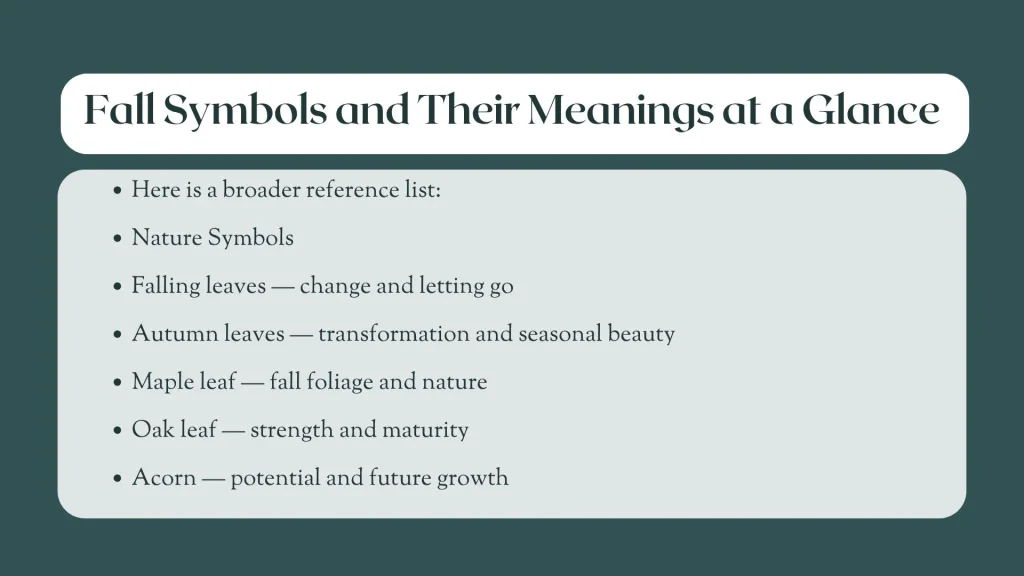
Here is a broader reference list:
Nature Symbols
- Falling leaves — change and letting go
- Autumn leaves — transformation and seasonal beauty
- Maple leaf — fall foliage and nature
- Oak leaf — strength and maturity
- Acorn — potential and future growth
- Pinecone — woodland nature and resilience
- Bare branches — transition and dormancy
Harvest Symbols
- Pumpkin — autumn, harvest, celebration
- Apple — harvest and nourishment
- Corn — agriculture and abundance
- Wheat — provision and harvest
- Squash — seasonal food and harvest
- Hay bale — farming and rural life
- Cornucopia — abundance and plenty
- Harvest basket — gathering and gratitude
Seasonal Atmosphere
- Orange — warmth and autumn
- Gold — richness and maturity
- Red — intensity and warmth
- Brown — earth and stability
- Cooler evenings — seasonal transition
- Shorter days — movement toward winter
Celebration Symbols
- Jack-o’-lantern — Halloween
- Scarecrow — farming and harvest
- Halloween bat — Halloween and nighttime imagery
- Black cat — Halloween and folklore
- Bonfire — seasonal gathering in some traditions
- Autumn wreath — seasonal welcome and decoration
A Simple Way to Understand Any Fall Symbol
When you encounter an unfamiliar autumn symbol, ask three questions.
What is it?
Identify the object, event, plant, animal, or color.
Why is it connected with fall?
Look for its relationship with nature, agriculture, food, weather, or a seasonal celebration.
What does it represent in this particular context?
This is the most important question because the same symbol can mean different things in different settings.
For example, an apple can mean harvest in an autumn decoration, knowledge in a school illustration, or something else entirely in a religious or literary context.
Common Mistakes When Interpreting Fall Symbols
Assuming Every Meaning Is Universal
Symbolism changes between cultures, religions, historical periods, and communities.
A meaning that is common in one culture may not apply somewhere else.
Confusing Fall Symbols With Halloween Symbols
Halloween happens during fall, but Halloween imagery is only one part of autumn symbolism.
A leaf is a general fall symbol. A skeleton is much more specifically associated with Halloween.
Treating Modern Meanings as Ancient Traditions
Some autumn associations are very old, while others are modern commercial or design traditions.
For example, today’s pumpkin-spice culture is a modern seasonal association, not an ancient universal symbol of autumn.
Giving One Symbol Only One Meaning
A pumpkin can mean harvest, Halloween, food, decoration, or autumn lifestyle depending on context.
Good symbolic interpretation considers the surrounding message.
How to Choose a Fall Symbol for a Specific Meaning
Use this quick guide:
Do you want to represent change?
→ Choose a falling leaf.
Do you want to represent growth or potential?
→ Choose an acorn.
Do you want to represent abundance?
→ Choose a cornucopia or harvest basket.
Do you want to represent autumn itself?
→ Choose colorful leaves, a pumpkin, or a warm autumn palette.
Do you want to represent farming?
→ Choose wheat, corn, hay, or a scarecrow.
Do you want to represent Halloween?
→ Choose a jack-o’-lantern, bat, ghost, or black cat.
Do you want to represent transition or balance?
→ Choose the autumnal equinox.
Do you want to represent reflection and the passage of time?
→ A falling leaf or changing tree can communicate that idea naturally.
Why Do Leaves Change Color in Fall?
Leaves change color because seasonal conditions affect the chemistry of the leaf.
During the growing season, chlorophyll gives many leaves their green appearance and plays a key role in photosynthesis. As seasonal daylight and temperature conditions change, chlorophyll production declines and the green color fades. Other pigments can then become more visible, producing yellow, orange, and red tones.
Weather also affects how brilliant autumn colors become. The U.S. Forest Service notes that combinations of temperature, sunlight, and other conditions can influence the intensity of fall coloration.
So the colorful leaf is both a real biological phenomenon and a powerful cultural symbol.
When Does Fall Start?
There are two common ways to define the beginning of fall.
Meteorological Fall
Meteorologists commonly divide the year into three-month seasons. In the Northern Hemisphere, meteorological fall is September, October, and November.
Astronomical Fall
Astronomical autumn begins with the September equinox in the Northern Hemisphere.
In 2026, NASA lists the September equinox as occurring on September 23 at 00:05 UTC, which corresponds to September 22 in some North American time zones.
The Southern Hemisphere experiences the opposite seasonal pattern, so September marks astronomical spring there.
This distinction is useful because people sometimes use “first day of fall” to mean two different things.
Frequently Asked Questions About Fall Symbols
What is the most common symbol of fall?
Falling or colorful autumn leaves are among the most widely recognized symbols of fall because they visibly show seasonal change. Pumpkins, acorns, apples, and warm autumn colors are also strongly associated with the season.
What does a fall leaf symbolize?
A fall leaf can symbolize change, transition, letting go, maturity, impermanence, and the passage of time. The meaning depends on the context in which the leaf is used.
What does a pumpkin symbolize in fall?
A pumpkin can represent autumn, harvest, seasonal food, abundance, decoration, and celebration. When carved as a jack-o’-lantern, its connection to Halloween becomes much stronger.
What does an acorn symbolize?
An acorn commonly represents potential, growth, strength, and future possibilities because it contains the seed from which an oak can grow.
What symbolizes autumn besides leaves?
Common alternatives include pumpkins, acorns, apples, corn, wheat, pinecones, scarecrows, harvest baskets, cornucopias, warm colors, and the autumnal equinox.
What color represents fall?
There is no single official “fall color,” but orange, red, yellow, gold, brown, rust, and burgundy are strongly associated with autumn because they reflect seasonal foliage and established fall design traditions.
Is a pumpkin a fall or Halloween symbol?
It can be both. A whole pumpkin is a broad fall and harvest symbol, while a carved jack-o’-lantern is more specifically associated with Halloween.
What symbolizes change in autumn?
The falling leaf is one of the clearest symbols of change because it visibly moves from growth and color to separation from the tree.
What symbolizes abundance in fall?
Cornucopias, harvest baskets, pumpkins, wheat, corn, and overflowing produce can symbolize abundance and the gathering of a harvest.
Does fall have the same meaning everywhere?
No. Seasonal symbolism varies by culture, geography, religion, history, and personal experience. Fall itself also occurs at different times in the two hemispheres.
Is the autumn equinox the same as the first day of fall?
It depends on which definition of “fall” is being used. Meteorological autumn follows a calendar-based three-month system, while astronomical autumn begins with the September equinox in the Northern Hemisphere.
Key Takeaways About Fall Symbols
- Falling leaves commonly represent change and letting go.
- Colorful leaves can represent transformation and seasonal beauty.
- Acorns can represent potential and future growth.
- Pumpkins connect with autumn, harvest, and Halloween.
- Apples, corn, and wheat are strongly connected with harvest.
- Cornucopias represent abundance and plenty.
- Scarecrows represent farming and rural harvest imagery.
- Warm colors create a recognizable autumn visual language.
- The autumn equinox represents a real seasonal and astronomical transition.
- Halloween symbols overlap with fall but should not automatically be treated as general autumn symbols.
- Symbolic meanings are context-dependent, so one object can represent several different ideas.

I’m Grace Harrison, a writer who loves exploring the meaning and everyday use of English words and expressions. I enjoy researching unfamiliar terms and explaining them in a way that feels natural and easy to understand. At Meanera, I create helpful content about vocabulary, slang, phrases, and expressions so readers can understand language with confidence.
Books:
- The Language of Everyday Life
- Simple Meanings, Clear Words