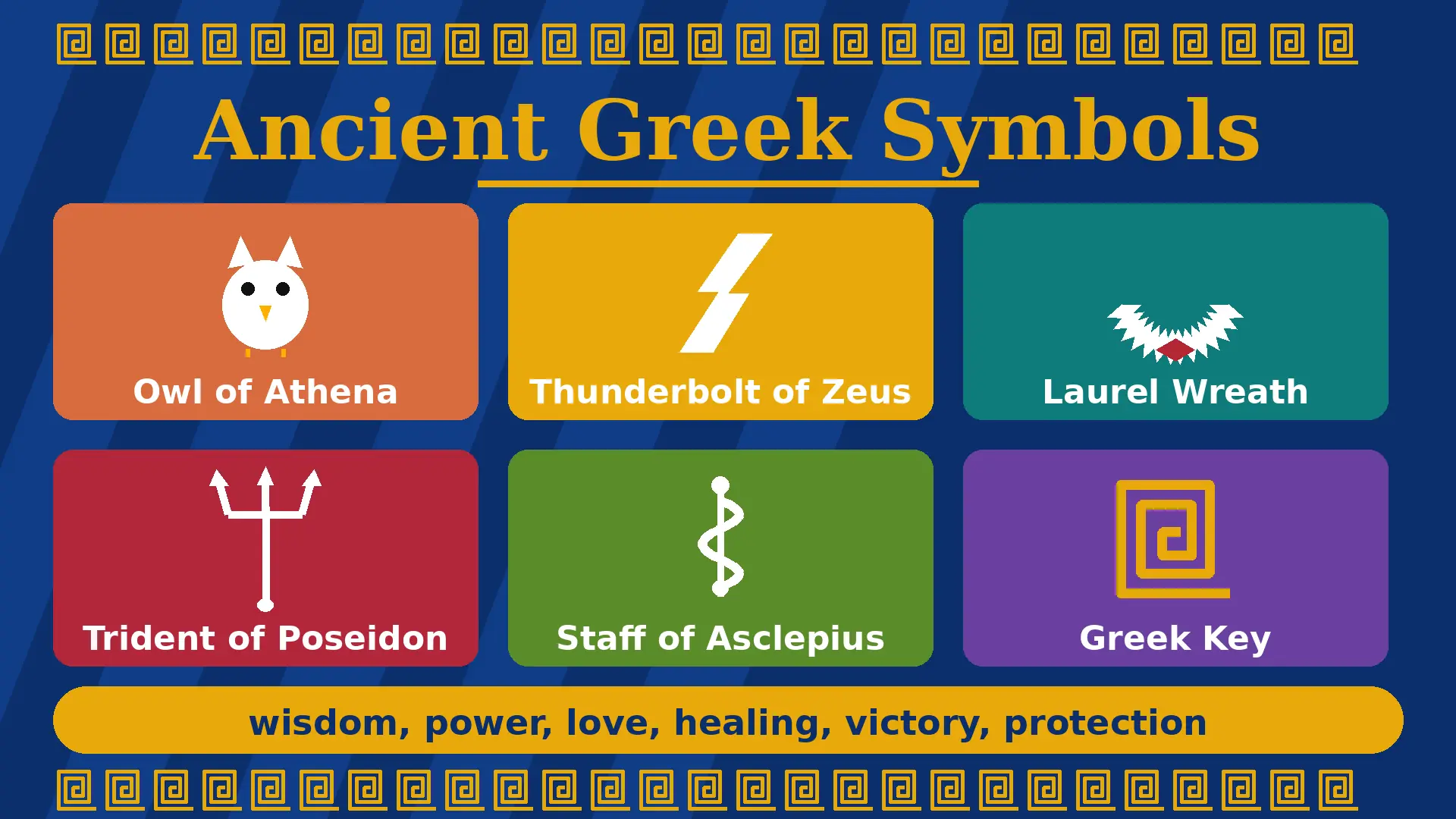
Ancient Greek symbols reveal how one of history’s most influential civilizations expressed ideas about wisdom, power, love, healing, victory, protection, and the natural world. From the owl associated with Athena to the thunderbolt of Zeus, these symbols appeared in mythology, religious practices, coins, pottery, architecture, and everyday objects. Many remain recognizable thousands of years later, although their meanings have sometimes changed.
Some ancient Greek symbols represented particular gods and goddesses. Others served as decorative patterns, civic emblems, protective images, or identifying features in works of art. The laurel wreath, for example, was associated with victory and honor, while the staff of Asclepius became an enduring emblem of healing. The Greek key pattern, meanwhile, is famous for its geometric design, but its precise meaning to ancient viewers is less certain than many modern explanations suggest.
Understanding these symbols requires more than memorizing a list of meanings. Their significance depends on the historical period, the object on which they appeared, and the cultural traditions surrounding them. A symbol connected with a Greek god might communicate religious authority in one setting and serve as a decorative motif in another.
This comprehensive guide explores the most important ancient Greek symbols, their historical origins, mythological associations, documented uses, and modern interpretations. It also explains how to distinguish similar symbols, recognize misleading claims, and choose historically meaningful designs for research, jewelry, tattoos, and art.
What Are Ancient Greek Symbols?
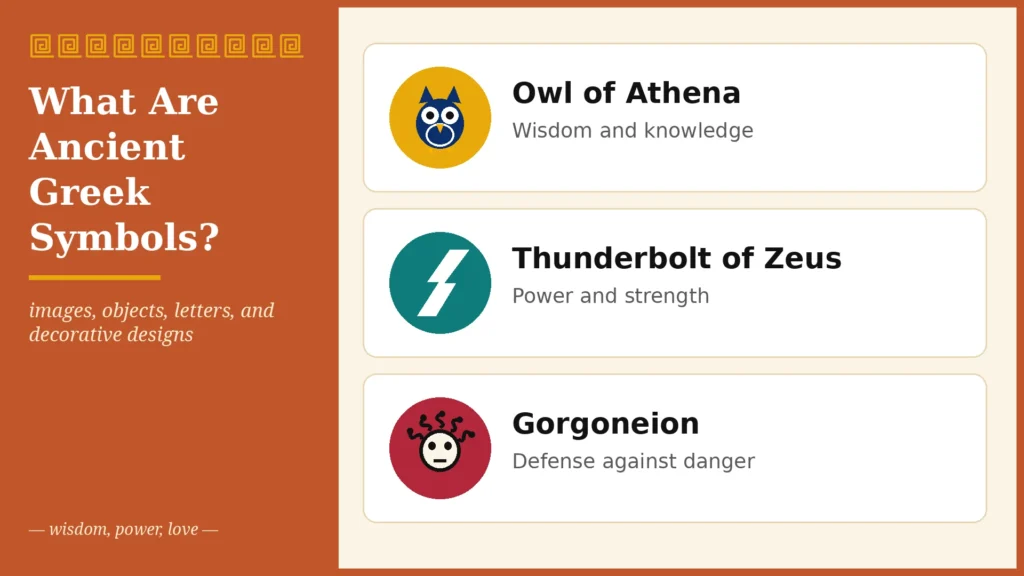
Ancient Greek symbols were images, objects, letters, and decorative designs that communicated religious beliefs, cultural identity, civic values, and ideas about the world. They developed across different periods of Greek history, from the Bronze Age Aegean civilizations to the classical city-states and the Hellenistic kingdoms.
These symbols were not all used in the same way. Some identified gods in paintings and sculptures, while others appeared on coins, shields, buildings, ceremonial objects, and household pottery. Greek letters also developed uses beyond ordinary writing, becoming important in mathematics, philosophy, science, and religious texts.
Ancient Greek symbolism can be understood through several broad categories.
- Mythological symbols: Objects and animals associated with particular gods, goddesses, and heroes, such as Zeus’s thunderbolt and Athena’s owl.
- Religious symbols: Images and objects used in worship, festivals, sanctuaries, and ritual settings.
- Protective symbols: Images such as the Gorgoneion, which could be used to repel danger or harmful forces.
- Artistic and architectural motifs: Decorative designs such as the meander pattern, palmettes, and stylized plant forms.
- Civic and athletic symbols: Emblems associated with cities, coinage, public identity, and competitive achievement.
- Alphabetic and mathematical symbols: Greek letters used for writing, calculation, and specialized notation.
It is important to remember that ancient Greek culture lasted for many centuries and included numerous regional traditions. A symbol found on a classical Athenian coin may have a different historical context from a similar motif on an earlier Aegean object.
Not every familiar Greek design originated exclusively in Greece, and not every symbol had one universally accepted meaning. The most reliable interpretations come from examining surviving artifacts, ancient literature, inscriptions, and the contexts in which symbols were used.
Ancient Greek Symbols and Their Meanings: Quick Reference Chart
The following chart provides a starting point for identifying major ancient Greek symbols. The historical association column describes their best-known traditional connections, while the modern meaning column identifies interpretations commonly used today.
| Ancient Greek symbol | Historical association | Common modern meaning |
|---|---|---|
| Owl of Athena | Athena and the city of Athens | Wisdom and knowledge |
| Thunderbolt of Zeus | Zeus's divine authority | Power and strength |
| Laurel wreath | Apollo and victory at the Pythian Games | Achievement and honor |
| Trident of Poseidon | The sea and earthquakes | Power and control |
| Staff of Asclepius | Healing and medicine | Healthcare and recovery |
| Caduceus of Hermes | Travel, commerce, and communication | Negotiation and communication |
| Gorgoneion | Gorgon imagery used for protection | Defense against danger |
| Olive branch | Sacred traditions and athletic honors | Peace and reconciliation |
| Greek key or meander | Geometric artistic decoration | Continuity and unity |
| Lyre of Apollo | Music, poetry, and performance | Creativity and artistic expression |
| Thyrsus of Dionysus | Dionysian worship and mythology | Celebration and ecstatic energy |
| Serpent | Various religious, healing, and mythological contexts | Renewal or transformation |
| Dolphin | Maritime life and sea-related mythology | Connection with the sea |
| Labyrinth | The myth of Theseus and the Minotaur | Complexity and personal journeys |
| Cornucopia | Mythological traditions of abundance | Prosperity and plenty |
| Wheat and grain | Demeter and agricultural fertility | Growth and nourishment |
| Winged sandals of Hermes | Divine messages and rapid travel | Speed and freedom |
| Aegis | Divine protection, especially in association with Athena and Zeus | Protection and authority |
These meanings are useful summaries, not a universal code. The historical evidence for a symbol’s association with a god may be strong, while a popular modern meaning may be an interpretation that developed much later.
Famous Ancient Greek Symbols Explained in Detail
The Owl of Athena: Wisdom, Knowledge, and Athenian Identity
The owl is one of the most recognizable symbols in ancient Greek culture. It was closely associated with Athena, the goddess of wisdom, strategic warfare, crafts, and practical intelligence.
In Greek mythology, Athena was a powerful protector of cities and a patron of activities that required planning, skill, and sound judgment. The owl became a recognizable attribute of the goddess, helping artists identify her in visual representations.
The owl also had an important role beyond mythology. Ancient Athens used the owl on its coinage, often alongside an image of Athena wearing a helmet. Surviving Athenian silver coins show the bird on one side and the goddess on the other, sometimes accompanied by an olive branch and an inscription identifying the Athenians. These coins demonstrate how religious imagery and civic identity could work together.
What does the owl of Athena mean?
- Wisdom: Its strongest traditional association is with Athena and intelligent judgment.
- Knowledge: It has become an enduring emblem of education and learning.
- Observation: The owl’s distinctive vision encourages modern interpretations involving attentiveness and insight.
- Civic identity: On Athenian coins, the owl helped identify the issuing city.
- Strategic thinking: Its connection with Athena links it to planning and practical intelligence.
Today, the owl appears on educational emblems, book covers, jewelry, and tattoos. If you want a design with a particularly strong historical foundation, an owl modeled on an ancient Athenian coin is a good option.
One important distinction is that the owl did not simply mean “wisdom” in every ancient Greek context. Its connection to Athena and Athens is particularly well established, while broader interpretations depend on the specific artwork.
The Thunderbolt of Zeus: Divine Power and Authority
Zeus was the king of the Olympian gods and a central figure in Greek mythology. His thunderbolt was his signature weapon and one of the clearest visual attributes used to identify him.
In mythological stories, Zeus uses thunder and lightning to demonstrate his extraordinary power. The thunderbolt represents his ability to defeat opponents and exercise authority among gods and mortals.
Ancient Greek artists depicted the thunderbolt in different stylized forms. It could appear as a zigzag shape, a bundle of lightning-like lines, or an elaborate object held by Zeus.
The thunderbolt is associated with:
- Divine authority and command
- Strength and overwhelming power
- Judgment and punishment
- The forces of the sky
- The restoration or enforcement of order in mythological narratives
For modern audiences, the thunderbolt often suggests energy, determination, speed, and personal strength. These are understandable contemporary interpretations, but the symbol’s principal mythological association is Zeus’s divine power.
For a historically informed tattoo or piece of jewelry, a thunderbolt depicted in the style of Greek sculpture or pottery may communicate the connection more clearly than a generic modern lightning icon.
The Laurel Wreath: Victory, Honor, and Excellence
The laurel wreath was an important symbol of achievement in ancient Greek religious and athletic traditions. It was particularly associated with Apollo, the god of music, poetry, prophecy, and several other domains.
At Delphi, the Pythian Games honored Apollo, and victorious competitors received laurel wreaths. This association connected the plant with achievement and sacred recognition.
However, the laurel wreath should not be confused with the prizes awarded at every Greek festival. At the ancient Olympic Games, victors received wreaths made from wild olive, known as kotinos. The distinction matters because different festivals had their own traditions and sacred associations.
Common meanings of the laurel wreath include:
- Victory and accomplishment
- Honor and recognition
- Artistic and intellectual excellence
- Glory and distinction
- Dedication to a goal
The wreath became a lasting emblem of success and later influenced Roman and European traditions of honoring distinguished people.
Today, laurel wreaths appear on medals, certificates, academic insignia, logos, and tattoos. They are especially appropriate for designs celebrating a personal achievement, provided the modern meaning is understood alongside the symbol’s historical background.
The Trident of Poseidon: The Sea and Natural Forces
Poseidon was the Greek god of the sea, earthquakes, and horses. His trident, a three-pronged spear, served as his most recognizable attribute.
The sea was central to ancient Greek life. Maritime travel connected communities, trade supported cities, and fishing supplied food. At the same time, storms and dangerous waters threatened ships and coastal settlements.
Poseidon embodied both the opportunities and the dangers of the natural world. In mythology, his trident could demonstrate his dominion over the sea and his capacity to disturb the earth.
The trident is associated with:
- The sea and maritime life
- Divine authority over natural forces
- Power and command
- Earthquakes in Poseidon’s mythological role
- The relationship between people and the ocean
Modern designs sometimes use the trident to represent independence, resilience, or control. These meanings can be personally significant, but the historically grounded interpretation begins with Poseidon.
The trident also offers a useful example of why symbols should be interpreted in context: a three-pronged object is not automatically a reference to Poseidon unless the surrounding design or historical evidence supports that identification.
The Staff of Asclepius: Healing and Medicine
Asclepius was the Greek god of healing and medicine. His most recognizable attribute is a staff with a single serpent wrapped around it.
People seeking healing in ancient Greece visited sanctuaries dedicated to Asclepius, known as Asclepieia. These places combined religious traditions with healing practices, and visitors might participate in rituals or seek interpretations of dreams.
The staff became a lasting identifier of Asclepius and his healing role. The serpent’s place in this imagery is significant, although its meaning should not be reduced to a single explanation.
The staff of Asclepius represents:
- Healing and recovery
- Medical knowledge
- Care for the sick
- Restoration and well-being
- The historical traditions of Greek medicine
The symbol remains widely used in healthcare and medical organizations.
It is particularly important to distinguish this staff from the caduceus of Hermes. The staff of Asclepius has one serpent and no wings, while the caduceus typically has two intertwined serpents and wings. Although the caduceus has also been adopted by some modern medical organizations, its original Greek association is with Hermes, not Asclepius.
Science Museum Group Blog
+1
The Caduceus of Hermes: Communication, Travel, and Commerce
Hermes was the messenger of the gods and a deity associated with travel, commerce, boundaries, cleverness, and communication. His caduceus was a staff traditionally depicted with two intertwined serpents and, in many representations, wings.
Hermes moved between different places and realms, carrying messages and guiding travelers. His varied responsibilities made him an important figure in trade, diplomacy, and movement.
The caduceus is associated with:
- Communication and messages
- Trade and commerce
- Travel and movement
- Negotiation and exchange
- Cleverness and adaptability
The symbol’s modern use can be confusing because it is sometimes mistaken for the staff of Asclepius. If your goal is to represent healing or medicine with historical accuracy, the single-serpent staff is the clearer choice.
If your interest is in trade, communication, or Hermes himself, the caduceus is more appropriate.
The Gorgoneion: Protection and the Power of Medusa’s Image
The Gorgoneion is an image of a Gorgon’s face, most famously associated with Medusa. It appeared in ancient Greek visual culture on objects such as shields, armor, pottery, and architectural decoration.
In Greek mythology, Medusa’s gaze could turn people to stone. Her frightening appearance made her image a powerful artistic motif.
The Gorgoneion could function as an apotropaic image: an image intended to avert evil or repel danger. Its intimidating appearance was therefore not merely decorative. In certain contexts, the image could communicate protection by confronting a potential threat with another threatening force.
Its associations include:
- Protection from harmful forces
- Defense and intimidation
- Mythological power
- The use of frightening imagery to repel danger
- The relationship between fear and protection
The Gorgoneion is not exactly the same thing as the entire Medusa myth. The term refers to the image of the Gorgon’s face, while the story of Medusa includes her identity, her encounter with Perseus, and her place in a wider body of mythology.
For readers interested in protective symbols, this distinction helps separate the historical use of an image from modern interpretations of Medusa as a figure of personal strength or resistance.
The Olive Branch: Sacred Honor, Prosperity, and Peace
The olive tree was central to ancient Greek agriculture and religious life. Its fruit provided food, while olive oil served many practical and ceremonial purposes.
The olive tree was also connected with Athena. In the myth explaining Athena’s patronage of Athens, her gift of the olive tree demonstrated its value to the community.
Olive branches and wreaths appeared in different ceremonial contexts. The wild olive wreath awarded at the Olympic Games is one important example of the plant’s association with honor and victory.
The olive branch can be understood through several related associations:
- Agricultural prosperity and nourishment
- Sacred traditions linked to Athena
- Honor and victory in specific athletic contexts
- Peace and reconciliation in later and broader symbolic use
The olive branch is now widely recognized as a sign of peace. Its ancient history, however, is richer than that single meaning. It was connected with practical resources, divine patronage, and public ceremonies.
The Greek Key Pattern: Geometry, Continuity, and Decoration
The Greek key, commonly called the meander, is a repeating geometric pattern built from connected lines and angular turns.
It appeared in Greek pottery, architectural ornament, textiles, and other decorative forms. Its repeating design made it useful for borders and surfaces where artists wanted a continuous visual rhythm.
The name “meander” is often associated with the winding course of the Maeander River in Asia Minor. Nevertheless, geometric patterns of this kind have a wider history, and their development should not be attributed to a single culture without qualification.
Today, the Greek key is frequently interpreted as a symbol of eternity, continuity, unity, and the interconnectedness of life.
Those interpretations are popular in modern jewelry, tattoos, interior design, and architecture. However, the precise symbolic meaning assigned to the pattern by every ancient Greek artist or viewer is not established.
For a historical article, the safest explanation is that the meander was an important decorative motif whose modern interpretations often emphasize continuity and permanence.
The Serpent: Healing, Guardianship, and Sacred Power
Serpents appeared in Greek myths, religious traditions, and works of art. Their significance varied according to the deity, location, and story with which they were associated.
The serpent on the staff of Asclepius connects snake imagery directly with healing. Other serpents appeared in mythological narratives involving guardianship, heroes, the earth, and supernatural beings.
The shedding of a snake’s skin encourages modern interpretations involving renewal and transformation. Its potentially dangerous bite, meanwhile, helps explain why snakes could also evoke fear or supernatural power.
Possible associations include:
- Healing and restoration
- Guardianship and protection
- Renewal and transformation
- Connections with the earth
- Sacred or supernatural forces
These associations should not be treated as interchangeable. A serpent connected with Asclepius has a different historical context from a serpent appearing in another myth.
The Dolphin: Maritime Life and the World of the Gods
Dolphins were familiar animals in the Mediterranean and appeared in ancient Greek art, including pottery and decorative designs. They also featured in mythological stories associated with the sea and divine intervention.
Their presence reflects the importance of maritime life in Greek society. Ships connected settlements, enabled trade, and carried travelers across the Aegean and beyond.
Dolphin imagery could evoke the sea and its mythological associations, although the exact meaning of a particular image depends on its context.
Common modern interpretations include friendship, intelligence, freedom, and harmony with nature. These should be distinguished from the more specific historical associations that can be established for an individual artifact.
The Labyrinth: Theseus, the Minotaur, and a Difficult Journey
The labyrinth is best known from the Greek myth of Theseus and the Minotaur. In the story, the Minotaur lived within a complex structure on Crete, and Theseus entered it to confront the creature.
Ariadne helped Theseus by giving him a thread that allowed him to retrace his route and escape. The story therefore involves courage, intelligence, assistance, and the challenge of navigating a dangerous environment.
The labyrinth has since become a powerful image for complex journeys and difficult choices.
Modern interpretations include:
- A challenging personal journey
- Confusion and complexity
- Courage in the face of danger
- The search for understanding
- Finding a path through uncertainty
These interpretations draw on the story’s themes. They should not be presented as the single documented meaning of every ancient labyrinth design.
The relationship between the myth and Bronze Age Crete is historically interesting, but the precise origins of the labyrinth tradition should be approached cautiously rather than treated as a fully resolved archaeological fact.
The Lyre of Apollo: Music, Poetry, and Artistic Excellence
The lyre was an important musical instrument in ancient Greek culture. It was associated with Apollo, who was connected with music, poetry, prophecy, and artistic excellence.
The lyre was used in musical performance and formed part of the wider world of Greek education, poetry, and cultural life. Its appearance in art could identify Apollo or evoke music and poetic accomplishment.
Its major associations include:
- Music and performance
- Poetry and artistic expression
- Harmony and cultivated skill
- Apollo’s cultural and religious role
The lyre differs from a modern guitar or harp in its historical construction and playing traditions. For a historically informed design, it is worth using a representation based on ancient Greek instruments rather than a generic stringed instrument.
The Thyrsus of Dionysus: Celebration, Nature, and Religious Ecstasy
Dionysus was associated with wine, vegetation, theatrical performance, festivals, and ecstatic religious experience. One of his distinctive attributes was the thyrsus, a staff often depicted with a pinecone at the top and wrapped with foliage.
The thyrsus appeared in artistic representations of Dionysus and his followers. It helped identify the god and the distinctive religious world surrounding his worship.
The symbol can be associated with:
- Dionysian religious traditions
- Wine and celebration
- Vegetation and natural growth
- Ritual ecstasy and altered states
- The theatrical and festive aspects of Greek culture
The thyrsus is more specific than a generic staff or plant motif. Its identification is strongest when its characteristic form or connection with Dionysus appears in the surrounding artwork.
The Cornucopia: Abundance and Nourishment
The cornucopia, or horn of plenty, is a horn-shaped container overflowing with produce. Greek mythological traditions offer different explanations for its origin, including stories connected with the nourishment of Zeus.
The object became associated with abundance because it represents a seemingly inexhaustible supply of food and valuable resources.
Its common modern associations include prosperity, fertility, generosity, nourishment, and agricultural success.
The cornucopia is useful to include in a discussion of Greek symbolism because it connects mythology with the everyday importance of food, farming, and material well-being. However, its use continued and evolved across later cultures, so not every modern cornucopia design should automatically be treated as an unchanged ancient Greek symbol.
Ancient Greek Symbols Associated With Gods and Goddesses
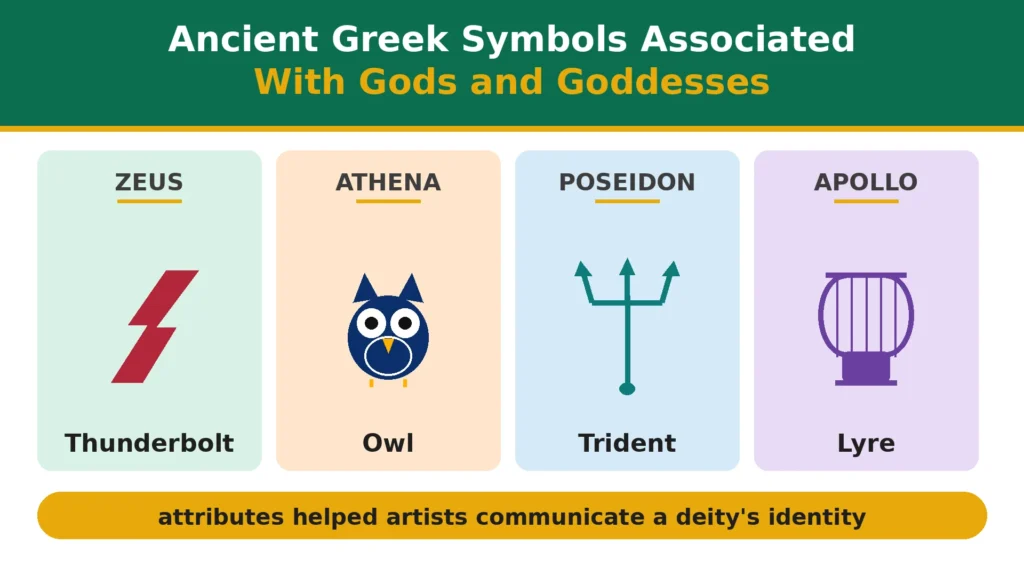
Greek gods and goddesses were often identified by objects, animals, plants, or weapons associated with their stories and powers. These attributes helped artists communicate a deity’s identity even when no inscription was present.
Understanding the relationships between the gods and their symbols makes it easier to identify ancient Greek art and avoid confusing similar figures.
Zeus and Athena: Thunderbolt and Owl
Zeus and Athena provide two clear examples of how divine symbols communicated different kinds of power.
Zeus’s thunderbolt represented his authority and extraordinary control over the forces associated with the sky. Athena’s owl, by contrast, identified her connection with wisdom and was also important to Athenian civic identity.
Their symbols demonstrate that ancient Greek mythology connected divine power with recognizable visual objects. The thunderbolt emphasized authority, while the owl communicated intelligence and the identity of a particular city.
Poseidon and Apollo: Trident and Lyre
Poseidon’s trident identified his relationship with the sea, earthquakes, and horses. Apollo’s lyre emphasized his connections with music, poetry, and artistic achievement.
These attributes helped viewers distinguish gods whose powers and stories were different. The objects were not simply generic decorations: their associations with particular deities were central to their role in Greek art.
Aphrodite: Love, Beauty, Myrtle, and Doves
Aphrodite was the goddess of love, beauty, and desire. Myrtle and doves are among the plants and animals associated with her in ancient traditions.
These associations make Aphrodite particularly relevant to readers interested in Greek symbols of love. However, modern romantic meanings should not be applied automatically to every depiction of a dove or flowering plant in Greek art.
When identifying a symbol, look for the broader scene, the objects accompanying the figure, and any available historical description.
Demeter: Wheat, Grain, and Agricultural Fertility
Demeter was associated with agriculture, grain, and the fertility of cultivated land. Her mythology was deeply connected with the cycle of growth, harvest, and the survival of human communities.
Grain imagery therefore has a particularly meaningful place in traditions associated with Demeter. It can communicate nourishment, agriculture, and the relationship between people and the land.
Grain was also an everyday resource, so its appearance on an object did not necessarily mean that the object had a religious purpose. Context remains essential.
Artemis: Bow, Deer, and Wilderness
Artemis was associated with hunting, wild animals, and the wilderness. Her bow and arrows are among her recognizable attributes, while deer appear in artistic and mythological contexts connected with her.
These symbols emphasize her relationship with the natural world and the challenges of hunting. They also help distinguish Artemis from other Greek goddesses whose attributes focus on wisdom, love, or agriculture.
Dionysus: Grapevine, Wine, and the Thyrsus
Dionysus was connected with wine, vegetation, festivals, and theatrical traditions. Grapevines, drinking vessels, and the thyrsus can help identify imagery associated with him.
These objects reveal how Greek symbolism could connect a god with a substance, a plant, a ritual object, and a broader cultural practice.
The grapevine is not exclusively a symbol of Dionysus in every context, but its association with the god is important when it appears alongside his other attributes.
Ancient Greek Symbols of Wisdom, Love, Power, and Protection
Readers often search for ancient Greek symbols by the idea they want to represent rather than by a deity’s name. Grouping symbols by theme helps make the article more practical without losing historical context.
Ancient Greek Symbols of Wisdom and Knowledge
The owl of Athena is the clearest starting point for wisdom. Its connection with the goddess and its appearance on Athenian coinage give it a strong historical foundation.
Athena herself is also an appropriate subject for a design intended to represent wisdom, strategic thinking, or practical skill.
A lyre may suit someone interested in artistic or intellectual achievement, especially where the design emphasizes Apollo and the Greek traditions of music and poetry.
The key distinction is that wisdom is most directly connected with Athena and her owl, whereas the lyre is more specifically associated with music and the arts.
Ancient Greek Symbols of Love and Beauty
Aphrodite is the principal Greek goddess associated with love and beauty. Her imagery and her traditional associations with myrtle and doves are useful starting points for readers exploring this theme.
A dove on its own, however, is not sufficient evidence that an ancient object was dedicated to Aphrodite. The bird had a wider life in art and religious traditions.
For modern jewelry or tattoos, an image of Aphrodite or a historically grounded combination of her attributes can communicate the intended connection more clearly than a generic heart shape presented as an ancient Greek symbol.
Ancient Greek Symbols of Strength and Power
Zeus’s thunderbolt represents divine power and authority, while Poseidon’s trident communicates his command over the sea and other natural forces associated with him.
The Gorgoneion offers a different kind of power: its frightening appearance could serve a protective or intimidating function.
These symbols can all suit modern designs focused on strength, but their historical associations differ. The thunderbolt is connected with divine authority, the trident with Poseidon, and the Gorgoneion with mythological imagery and protection.
Ancient Greek Symbols of Protection
The Gorgoneion is one of the strongest examples of an image used to repel harmful forces. Its appearance on shields and other objects illustrates how religious and mythological imagery could serve protective purposes.
Athena’s attributes also connect her with civic defense and strategic warfare. Serpent imagery, meanwhile, can be protective in some contexts but should not be assigned that meaning automatically.
For accurate interpretation, examine the symbol’s placement, the object on which it appears, and the other images surrounding it.
Ancient Greek Symbols of Peace and Prosperity
The olive branch and olive wreath are particularly relevant to this theme. Olive cultivation was important to Greek agriculture, and the olive tree was associated with Athena.
The wild olive wreath awarded at the ancient Olympic Games connected the plant with athletic honor. Olive branches also became widely recognized as symbols of peace, although their meanings vary across different historical traditions.
The cornucopia provides another useful symbol of abundance. Its overflowing contents communicate nourishment and prosperity, but its iconography developed through different cultural traditions and should be interpreted with attention to period and context.
Ancient Greek Symbols in Pottery, Architecture, Coins, and Religious Objects
Surviving artifacts are essential for understanding ancient Greek symbols. They provide physical evidence of how images were used, what they looked like, and which contexts gave them significance.
Symbols on Ancient Greek Coins
Coins are particularly useful because they often combine imagery with evidence of civic identity and economic life.
Athenian coins commonly depicted Athena on one side and an owl on the other. Some surviving examples also include an olive branch and an abbreviated inscription identifying the Athenians. The imagery linked the city’s patron goddess with a recognizable civic emblem.
Coins also circulated beyond the places where they were minted. As a result, the owl became recognizable in a wider Mediterranean world.
When studying an ancient coin, examine both sides, any inscriptions, the material, and the date. A symbol’s presence on a coin does not always indicate that it was a purely religious emblem; it may also have served civic, political, or economic purposes.
Symbols on Greek Pottery
Greek pottery preserved a wide variety of mythological and everyday scenes. Vessels could depict gods, heroes, animals, battles, athletic activities, ceremonies, and domestic life.
Different styles and periods used different visual conventions. Black-figure and red-figure pottery, for example, are important traditions of Greek vase painting, each with its own techniques and artistic development.
A painted owl beside Athena has a clear mythological association. A geometric border around the vessel may function primarily as ornament. A mythological scene can also combine several attributes, making the full composition more informative than any isolated image.
For reliable interpretation, look for museum descriptions that identify the vessel’s date, technique, subject, and archaeological context.
Symbols in Ancient Greek Architecture
Greek architecture used decorative motifs that could repeat along building surfaces, capitals, friezes, and other architectural elements.
The meander pattern and palmette are familiar examples of this decorative vocabulary. Their use demonstrates the importance of geometric and stylized plant forms in Greek design.
Not every architectural motif had a specific religious message. Some patterns were primarily ornamental, while others appeared within contexts that connected them with mythological figures or sacred buildings.
A useful distinction is to ask whether the motif identifies a particular god, illustrates a story, serves a ceremonial purpose, or mainly creates a visual pattern.
Symbols in Religious Objects and Sanctuaries
Ancient Greek religious life involved offerings, festivals, sacred places, and objects associated with particular deities.
Sanctuaries dedicated to Asclepius, for example, connected the god’s imagery with traditions of healing. Objects found in such settings can help historians understand religious practices, although the precise function of an individual artifact may require specialist interpretation.
Protective images such as the Gorgoneion also appeared on objects that had practical purposes. Their presence illustrates how mythological imagery could be integrated into everyday material culture.
It is important not to assume that every object found in a sanctuary had a single ritual function or that every decorated object was used in worship.
Ancient Greek Symbols and Greek Letters: What Is the Difference?
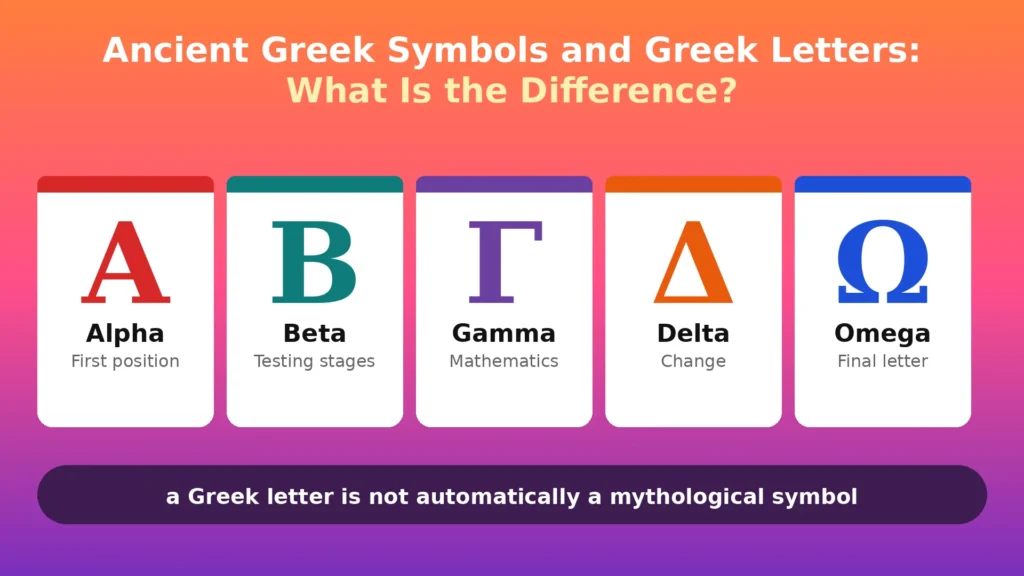
Greek letters are part of the Greek writing system, but they also acquired specialized roles in mathematics, science, philosophy, and other fields.
The distinction matters because a Greek letter is not automatically a mythological symbol. Its meaning depends on how and where it is used.
| Greek letter | Name | Common modern use |
|---|---|---|
| Α α | Alpha | First position or beginning |
| Β β | Beta | Testing stages and technical notation |
| Γ γ | Gamma | Mathematics and physics |
| Δ δ | Delta | Change or difference in mathematical contexts |
| Θ θ | Theta | Mathematical and scientific notation |
| Λ λ | Lambda | Mathematics, physics, and computing |
| Π π | Pi | The ratio of a circle's circumference to its diameter |
| Σ σ / ς | Sigma | Summation and statistical notation |
| Ω ω | Omega | Final letter of the Greek alphabet; used in scientific notation |
Some contemporary interpretations associate alpha with leadership and omega with completion. These are modern or later cultural uses, not universal definitions of how every ancient Greek understood the letters.
Greek letters also appear in inscriptions and religious writing. A letter’s meaning in a mathematical equation differs from its function in an ancient inscription or a word.
When researching a Greek character, first determine whether you are looking at an alphabetic letter, a specialized technical notation, or a symbol that belongs to a broader visual tradition.
Ancient Greek Symbols vs. Roman Symbols
Greek and Roman symbols are closely connected because Roman culture adopted and adapted many Greek gods, stories, artistic conventions, and religious practices. Nevertheless, Greek and Roman traditions are not identical.
Roman writers and artists often identified Greek deities with Roman counterparts. Zeus, for example, was commonly associated with Jupiter, while Athena was associated with Minerva and Poseidon with Neptune.
Their attributes could overlap, but their religious and civic contexts sometimes differed. A symbol appearing in Roman art may preserve a Greek mythological tradition while reflecting Roman artistic choices or religious practices.
| Greek deity | Common Roman counterpart | Recognizable attribute |
|---|---|---|
| Zeus | Jupiter | Thunderbolt |
| Athena | Minerva | Owl and other attributes |
| Poseidon | Neptune | Trident |
| Aphrodite | Venus | Myrtle and dove associations |
| Hermes | Mercury | Caduceus and winged sandals |
| Ares | Mars | Weapons and armor |
| Apollo | Apollo | Lyre and laurel associations |
| Artemis | Diana | Bow and hunting attributes |
| Demeter | Ceres | Grain and agricultural attributes |
| Dionysus | Bacchus | Grapevine and thyrsus |
These correspondences are useful guides, but they do not mean the gods were identical in every respect. Their stories, rituals, and cultural importance developed within different societies.
How to distinguish Greek and Roman symbols: examine the object’s date, inscriptions, artistic style, archaeological location, and associated figures. A familiar attribute alone may not establish whether an artifact is Greek or Roman.
This distinction is particularly important for people researching historical tattoos, classical sculptures, coins, and museum objects. A Roman depiction of a Greek deity can be historically valuable without being an original Greek artifact.
How to Choose an Ancient Greek Symbol for a Tattoo or Jewelry
Ancient Greek symbols remain popular in tattoos, pendants, rings, bracelets, and decorative designs because they connect a visual form with mythology and cultural history.
The best choice depends on what you want to communicate and how closely you want the design to reflect ancient evidence.
For Wisdom and Learning
Choose the owl of Athena if you want a symbol with a strong association with wisdom and knowledge. The owl’s appearance on ancient Athenian coins makes it particularly suitable for designs inspired by actual Greek artifacts.
An image of Athena may be more appropriate if you want to emphasize the goddess herself rather than one of her attributes.
For Strength and Authority
Zeus’s thunderbolt is suitable for a design centered on divine power, authority, or determination. Poseidon’s trident may appeal to someone interested in the sea, maritime history, or the god’s mythological role.
The Gorgoneion offers a different approach if you are interested in protection and intimidating imagery.
For Healing and Recovery
The staff of Asclepius is the clearest historically grounded choice for a design about medicine or healing.
If you choose a serpent design instead, investigate its specific context. Not every serpent motif in ancient Greek art represents Asclepius or medicine.
For Victory and Achievement
The laurel wreath is a strong option for celebrating success, dedication, or recognition. If you want a design based on a specific ancient athletic tradition, check which wreath was associated with that festival.
For example, the laurel is connected with Apollo and the Pythian Games, while the ancient Olympic victors received wild olive wreaths.
For Continuity and Geometric Design
The Greek key pattern works well for bands, borders, jewelry, and minimalist tattoos. Its continuous geometry encourages modern interpretations of unity and permanence.
However, choose it primarily because you appreciate the design and its historical artistic tradition, rather than assuming that every ancient Greek assigned it a precise spiritual meaning.
A Practical Checklist Before Choosing
Before committing to a design, ask yourself:
- Does the symbol have a documented ancient Greek association?
- Do I understand the difference between its historical meaning and its modern interpretation?
- Is the design based on an ancient artifact or a contemporary recreation?
- Am I confusing two similar symbols, such as the caduceus and staff of Asclepius?
- Would an inscription or Greek letter be historically and linguistically accurate?
- Does the design reflect the particular idea I want to communicate?
These checks help prevent common mistakes and make the finished design more meaningful.
Common Misconceptions About Ancient Greek Symbols
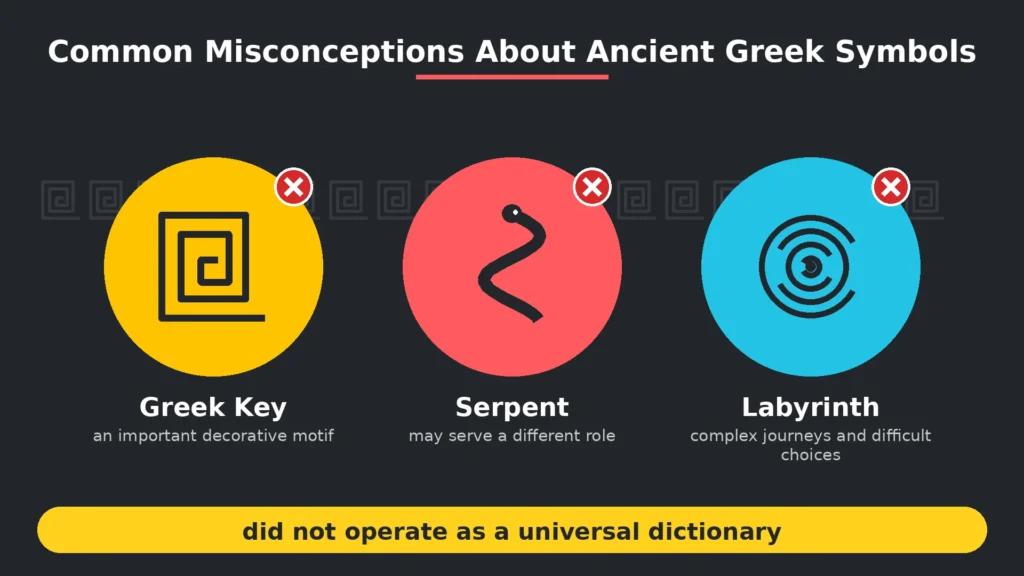
Ancient Greek symbolism is often simplified in modern lists, tattoo guides, and decorative design articles. The following distinctions help separate historical evidence from assumptions.
Every Greek Symbol Had One Fixed Meaning
Ancient Greek symbols did not operate as a universal dictionary. The same animal, plant, or pattern could appear in different settings and carry different associations.
A serpent associated with Asclepius has a clear connection with healing, but a serpent in another myth may serve a different role.
The most reliable interpretation comes from considering the object, date, location, and surrounding imagery.
The Greek Key Always Represented Infinity
The Greek key is an ancient geometric pattern. Its continuous form makes it easy to interpret as eternity or unity today, but this does not prove that all ancient Greeks understood it in exactly those terms.
The pattern’s documented use as decoration should be distinguished from later interpretations of its symbolism.
The Caduceus Was the Original Greek Medical Symbol
The caduceus is associated with Hermes and traditionally features two intertwined serpents, often with wings. The staff of Asclepius features one serpent and has the more direct historical connection with healing and medicine.
Modern organizations sometimes use the caduceus in healthcare contexts, but this later usage does not change its original mythological association.
All Ancient Greek Symbols Were Religious
Many symbols had religious significance, but Greek visual culture also included decorative patterns, civic emblems, coin designs, athletic honors, and everyday artistic motifs.
A meander border on a vessel, for example, may primarily serve a decorative purpose. An owl on an Athenian coin can communicate both mythological association and civic identity.
The presence of a recognizable motif is not enough to establish a religious function.
Modern Spiritual Meanings Were Always Ancient Greek Beliefs
Modern readers may associate the labyrinth with self-discovery, the serpent with personal transformation, or the Greek key with eternity. These interpretations can be meaningful, but they should not automatically be presented as established ancient beliefs.
For historical accuracy, distinguish between ancient literary evidence, surviving material culture, later cultural traditions, and contemporary personal interpretations.
Every Greek-Looking Design Is an Authentic Ancient Symbol
Modern designs sometimes combine Greek letters, geometric motifs, mythological figures, and invented decorative elements. A design may be inspired by Greek art without being an authentic historical symbol.
If authenticity matters, compare the design with museum objects, archaeological publications, or scholarly references rather than relying only on a modern graphic’s description.
How to Identify Authentic Ancient Greek Symbols
Correct identification requires attention to evidence rather than appearance alone.
Examine the Historical Object
When a symbol appears on a coin, vessel, sculpture, or building, record what kind of object it is and where it was found, if that information is available.
An owl on an ancient Athenian coin has a different evidential context from an owl on a modern pendant marketed as Greek-inspired jewelry.
Look at the Associated Figures
Symbols often become easier to identify when they appear with a god or goddess. A trident held by Poseidon, for example, is a stronger indication of his identity than an isolated three-pronged shape.
Likewise, a staff with one serpent may point to Asclepius, while a winged staff with two serpents is associated with Hermes.
Check the Date and Region
Ancient Greek culture changed over time. Bronze Age Aegean objects, archaic Greek coins, classical Athenian pottery, and Hellenistic sculptures belong to different historical settings.
A symbol’s design and use may change across those periods. Avoid assuming that an interpretation from classical Athens automatically applies to an earlier or later object.
Read Museum and Archaeological Descriptions
Museum catalogues often provide an object’s date, material, dimensions, subject, provenance, and relevant bibliography. These details help establish what is known and what remains uncertain.
For example, the Acropolis Museum’s catalogue records ancient Athenian coins showing Athena and an owl, while the Cleveland Museum of Art documents a tetradrachm dated to approximately 449–440 BCE with Athena, an owl, and other details. These identifiable objects provide a stronger basis for discussion than an unsourced symbol list.
Distinguish Evidence From Interpretation
When a source says a symbol “represents” something, ask what evidence supports that conclusion. It may be based on an ancient text, an inscription, repeated use alongside a deity, or a modern interpretation of a decorative form.
These are different kinds of evidence and should not be treated as equally conclusive.
Why Ancient Greek Symbols Still Matter Today
Ancient Greek symbols continue to influence education, medicine, architecture, art, literature, jewelry, and popular culture. Their lasting appeal comes partly from their recognizable forms and partly from the stories and ideas connected with them.
The owl of Athena continues to suggest wisdom, the laurel wreath communicates achievement, and the staff of Asclepius identifies healing traditions. The Greek key remains popular in decorative design, while the trident and thunderbolt continue to evoke powerful mythological figures.
These symbols also provide insight into how ancient Greek communities expressed their identities. Athenian coins, for example, connected a city with its patron goddess and recognizable owl imagery. Religious attributes helped artists identify deities, while protective images such as the Gorgoneion brought mythological imagery into material objects.
Studying these symbols therefore reveals more than a list of definitions. It helps explain the relationship between art, religion, politics, public life, and cultural memory.
Their continued popularity makes historical accuracy particularly valuable. A symbol can have a meaningful modern interpretation without that meaning being an established belief in ancient Greece.
Frequently Asked Questions About Ancient Greek Symbols
What is the most famous ancient Greek symbol?
The owl of Athena, Zeus’s thunderbolt, the laurel wreath, and the Greek key pattern are among the best-known symbols associated with ancient Greek culture. The owl is especially recognizable because it appeared on Athenian coins and was closely connected with Athena and the city of Athens.
There is no single official ranking of ancient Greek symbols, and the most recognizable example depends on whether the focus is mythology, decorative art, or modern design.
What ancient Greek symbol represents wisdom?
The owl is the best-known symbol associated with wisdom in ancient Greek culture because of its connection with Athena. The goddess herself also represents strategic thinking, practical intelligence, and skilled judgment.
The owl remains a popular choice for educational institutions, learning-related designs, and tattoos representing knowledge.
What is the ancient Greek symbol for strength?
Zeus’s thunderbolt is a prominent symbol of divine authority and power. Poseidon’s trident also communicates power through its association with the sea and other natural forces.
The Gorgoneion offers a different interpretation of strength, combining frightening imagery with the protective role it could serve on ancient objects.
What ancient Greek symbol represents healing?
The staff of Asclepius is the most direct traditional symbol of healing and medicine. It depicts a single serpent wrapped around a staff and is associated with Asclepius, the Greek god of healing.
It should be distinguished from Hermes’s caduceus, which typically has two serpents and wings.
What does the Greek key symbol mean?
The Greek key, or meander, is a geometric pattern used in ancient Greek decorative art. Today, it is often interpreted as representing eternity, unity, and continuity because of its repeating design.
However, these modern interpretations should not be presented as a single, universally documented ancient Greek meaning.
What ancient Greek symbol represents love?
Aphrodite, the goddess of love and beauty, is the central mythological figure associated with love in ancient Greek tradition. Myrtle and doves are among the attributes associated with her.
The meaning of a particular plant or bird still depends on its artistic and historical context.
What ancient Greek symbol represents protection?
The Gorgoneion, an image of a Gorgon’s face, is a notable example of protective imagery in ancient Greek art. It appeared on shields and other objects and could serve an apotropaic function, intended to repel danger or harmful forces.
Other images may also have protective associations, but these should be evaluated individually.
Did ancient Greeks use symbols for good luck?
Ancient Greek religious life included practices and objects intended to seek divine favor, avert danger, and promote well-being. Some images served protective functions, while offerings and rituals expressed relationships with the gods.
However, it would be misleading to classify every familiar Greek symbol as a good-luck charm. The function of each object depends on its historical context and evidence.
What is the difference between ancient Greek symbols and Greek mythology symbols?
Greek mythology symbols are a subset of ancient Greek symbolism. They include attributes associated with gods, goddesses, and heroes, such as Athena’s owl and Poseidon’s trident.
Ancient Greek symbolism also includes decorative patterns, civic emblems, coin imagery, religious objects, and alphabetic characters that may not be directly connected with mythology.
Which ancient Greek symbol is best for a tattoo?
The best symbol depends on the idea you want to represent. The owl of Athena is suitable for wisdom, the laurel wreath for achievement, the staff of Asclepius for healing, and the thunderbolt of Zeus for divine power.
If historical accuracy matters to you, verify the symbol’s ancient association and distinguish it from meanings developed in modern popular culture.
Where can I find authentic examples of ancient Greek symbols?
Museum collections, archaeological catalogues, and academic publications are reliable starting points. Look for records that identify an artifact’s date, material, origin, and imagery.
The Acropolis Museum and the Metropolitan Museum of Art both provide useful examples of ancient Greek objects and mythological imagery in their collections. The Cleveland Museum of Art also provides a documented example of an Athenian coin featuring Athena and an owl.
Final Thoughts on Ancient Greek Symbols and Their Meanings
Ancient Greek symbols provide a fascinating window into mythology, religion, art, public identity, and everyday life. The owl of Athena, thunderbolt of Zeus, laurel wreath, staff of Asclepius, Gorgoneion, and Greek key pattern each have distinctive histories and different kinds of significance.
Some symbols have clear historical associations supported by surviving artifacts and ancient traditions. Others are primarily decorative, or have acquired additional meanings through later cultural interpretations.
The most reliable way to understand an ancient Greek symbol is to examine where it appeared, which figures or objects accompanied it, and what historical evidence supports its interpretation. This approach is especially valuable when researching Greek mythology, studying classical art, or choosing a symbol for a tattoo or piece of jewelry.
Ultimately, ancient Greek symbols remain meaningful because they connect recognizable images with enduring questions about knowledge, power, healing, achievement, protection, and humanity’s relationship with the natural world. Understanding their history makes it possible to appreciate both their original cultural significance and the ways people continue to interpret them today.
Related Articles
- Hestia Symbols and Their Meanings: The Hearth, Sacred Fire, and More
- Celtic Symbols: Meanings, Origins, History & Which Ones Are Truly Ancient
- Aztec Symbols: Meanings, History, Gods, Animals, and Their Hidden Stories

I’m Lucas Thompson, a writer with a strong interest in vocabulary and everyday communication. I enjoy researching words that people encounter in conversations, online communities, and social media. At Meanera, I explain their meanings, context, and common usage in straightforward English so readers can find the answer they need quickly.
Books:
- The Everyday Wordbook
- English Beyond the Dictionary
 Grace Harrison
 Amelia Richardson