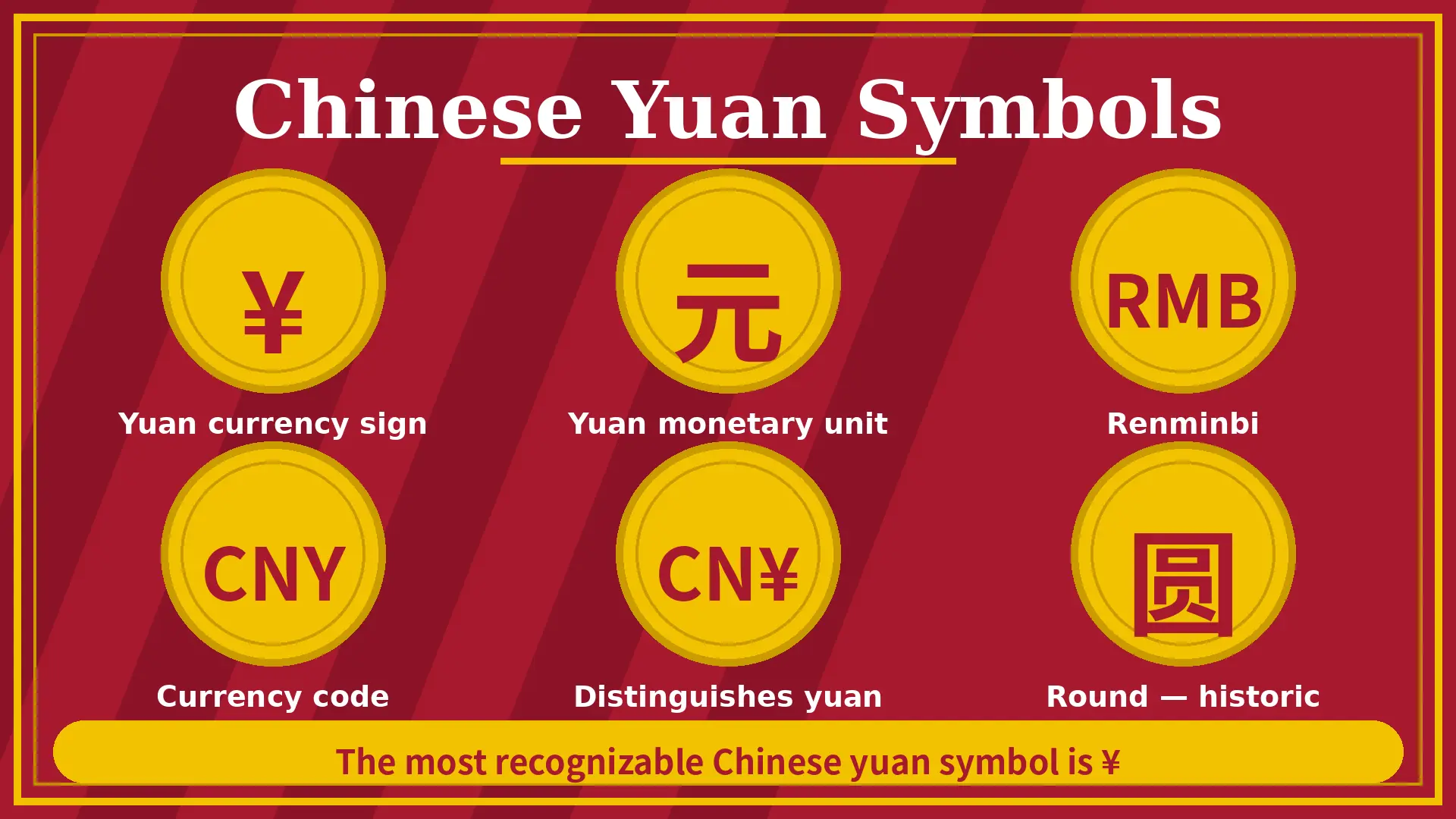
Chinese yuan symbols can be confusing, especially when you see different forms such as ¥, 元, RMB, CNY, or the strange text � on a website or in a document. Although these terms are related to China’s currency, they do not all mean the same thing.
The most recognizable Chinese yuan symbol is ¥. The Chinese character 元 represents the yuan monetary unit, RMB is an abbreviation for renminbi, and CNY is the standardized currency code used in international financial systems. Meanwhile, � is not a Chinese currency symbol. It may appear when text has been decoded or displayed incorrectly.
Understanding these differences can help you read Chinese product prices, compare currencies, complete international transactions, type Chinese currency symbols, and troubleshoot strange characters on websites.
This guide explains the main Chinese yuan symbols, their meanings, differences, usage, keyboard input methods, and common encoding problems. It also provides practical examples to help you recognize the correct symbol in everyday situations.
What Is the Chinese Yuan Symbol?
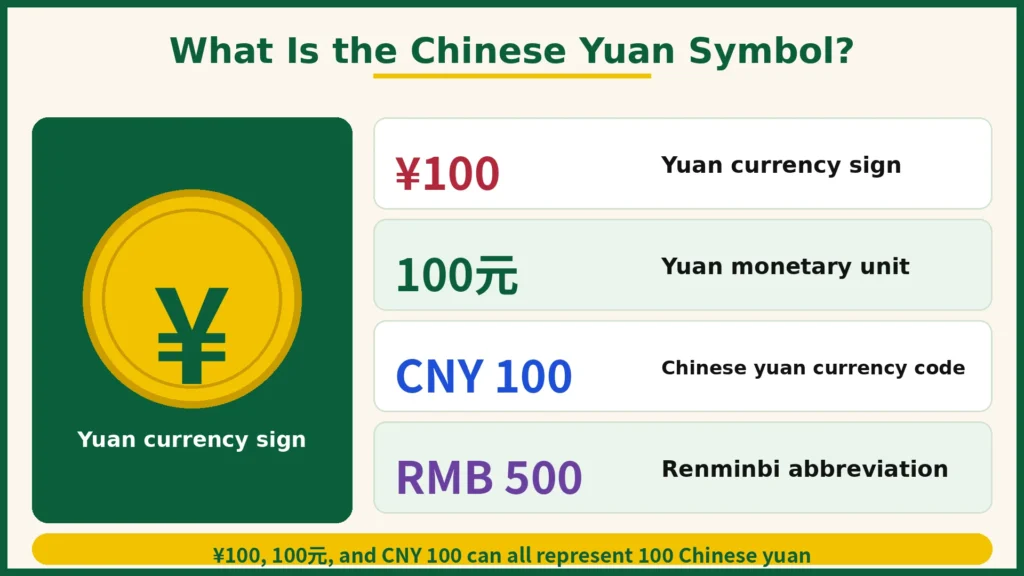
The main symbol commonly used for the Chinese yuan is ¥. It looks like the Japanese yen symbol because both currencies use the same basic sign. However, the Chinese yuan and Japanese yen are different currencies with separate currency codes and exchange rates.
China’s official currency is called the renminbi, which translates approximately as “people’s currency.” The yuan is its principal monetary unit. In everyday English, people frequently use “Chinese yuan” and “renminbi” interchangeably, even though the terms have slightly different meanings.
Here are the most important Chinese yuan symbols and abbreviations:
| Symbol or abbreviation | Meaning | Common use |
|---|---|---|
| ¥ | Yuan currency sign | Currency amounts and displayed prices |
| 元 | Yuan monetary unit | Chinese-language prices and financial writing |
| RMB | Renminbi abbreviation | General references to China's currency |
| CNY | Chinese yuan currency code | Banking, currency conversion, and financial systems |
| CN¥ | Notation distinguishing Chinese yuan | Some shopping and financial displays |
| 角 | Jiao | One-tenth of a yuan |
| 分 | Fen | One-hundredth of a yuan |
| 块 | Informal word for yuan | Everyday spoken Chinese |
| 毛 | Informal word for jiao | Everyday spoken Chinese |
These forms serve different purposes. A currency sign represents a monetary amount visually, a Chinese character identifies a monetary unit, and a currency code identifies the currency in a standardized format.
For example, ¥100, 100元, and CNY 100 can all represent 100 Chinese yuan when the surrounding context confirms that the currency is Chinese yuan. The notation ¥100 alone, however, can also refer to Japanese yen.
What Do the Main Chinese Yuan Symbols Mean?
Understanding each symbol individually is the easiest way to avoid confusion when reading prices or financial information.
The ¥ symbol: Chinese yuan sign
¥
Common currency sign for Chinese yuan
The symbol ¥ is used to display currency amounts. It often appears before the number, as in ¥50, ¥250, or ¥1,000.
Copy ¥ symbol
The sign is convenient because readers can recognize a currency amount quickly without reading a full currency name. It commonly appears on shopping websites, price tags, financial applications, currency converters, and other interfaces.
Examples include:
- ¥20 — 20 units of the currency identified by the surrounding context.
- ¥150 — 150 units of that currency.
- ¥2,500 — 2,500 units of that currency.
When the context clearly identifies mainland China’s currency, these amounts represent yuan. However, the symbol is also used for Japanese yen.
For international transactions, it is safer to use the code CNY when you need to specify Chinese yuan unambiguously.
The 元 character: yuan in Chinese writing
元
Chinese character for the yuan monetary unit
元 is commonly written after a number in Chinese prices. It identifies the unit rather than functioning as a standalone currency sign.
Copy 元 character
The character 元 is widely used in mainland China for prices, receipts, everyday transactions, and other monetary references.
Examples:
- 10元 means 10 yuan.
- 35元 means 35 yuan.
- 100元 means 100 yuan.
- 1,500元 means 1,500 yuan.
The symbol and character can therefore appear in different positions. A price may be displayed as ¥100 in one interface and 100元 in another.
This does not mean the characters are interchangeable in every context. The sign ¥ is a currency symbol, whereas 元 is the written Chinese monetary unit.
RMB: the abbreviation for renminbi
RMB stands for renminbi, the name of China’s currency. It is widely used in English-language business discussions, invoices, accounting documents, and descriptions of Chinese monetary amounts.
Examples:
- RMB 100 — 100 renminbi.
- RMB 800 — 800 renminbi.
- RMB 5,000 — 5,000 renminbi.
RMB is an abbreviation, not the standardized three-letter currency code used by international financial systems. That code is CNY.
The distinction is useful when comparing financial documents because a currency name abbreviation and a standardized code may appear in different fields or applications.
CNY: the international currency code
CNY is the ISO 4217 currency code for the Chinese yuan. It is used in international banking, exchange-rate displays, accounting systems, and financial data.
Examples:
- CNY 100 identifies 100 Chinese yuan.
- USD/CNY commonly identifies the US dollar–Chinese yuan currency pair.
- CNY to EUR describes a conversion between Chinese yuan and euros.
CNY is especially useful when an amount needs to be identified precisely. Unlike the shared ¥ sign, the code distinguishes Chinese yuan from Japanese yen, whose code is JPY.
For financial reporting, international transfers, and currency conversion, using the appropriate three-letter code helps reduce ambiguity.
CN¥: an alternative way to identify Chinese yuan
CN¥ combines a country identifier with the currency symbol. Some retailers and financial interfaces use this format to make clear that a price is expressed in Chinese yuan rather than Japanese yen.
For example, CN¥299 may identify a price of 299 Chinese yuan.
However, the format is not universal. Some websites use ¥, others use CNY, and others display the currency name in full. Always follow the currency label provided by the retailer, bank, or financial service.
The characters 圆 and 圓
圆 / 圓
Simplified and traditional Chinese characters
圆 is the simplified Chinese form, while 圓 is the traditional form. Both are related to the meaning “round” and have historical associations with monetary terminology.
Copy both characters
You may encounter 圆 or 圓 in historical materials, formal monetary expressions, or particular Chinese-language contexts. However, 元 is the more familiar character for the yuan unit in ordinary modern mainland Chinese price displays.
These characters should not be treated as interchangeable in every document. When writing a modern price, use the notation appropriate to the language, institution, or platform.
Chinese Yuan vs. Japanese Yen: Why Do They Share the Same Symbol?
One of the most common sources of confusion is that China and Japan both use ¥ as their commonly recognized currency sign. If you see this symbol on an international shopping website, you cannot always identify the currency from the sign alone.
The Chinese yuan and Japanese yen are separate currencies. They have different monetary systems, exchange rates, banknotes, and economic contexts.
¥
Chinese yuan
Currency code: CNY
China’s mainland currency, commonly called the yuan or renminbi.
¥
Japanese yen
Currency code: JPY
Japan’s currency, commonly called the yen.
How can you identify the correct currency?
Use the context in which the symbol appears.
- Chinese shopping website: The symbol may represent Chinese yuan, particularly if the store sells products priced for mainland China.
- Japanese shopping website: The symbol may represent Japanese yen, especially if the listing uses Japanese language and Japanese price conventions.
- Currency converter: Look for CNY or JPY in the currency selection or conversion pair.
- Bank statement: Check the currency code in the transaction details.
- International marketplace: Read the currency label and checkout information instead of assuming the symbol identifies the currency.
For example, CNY 500 and JPY 500 identify different currencies even though both amounts might be displayed using ¥ on their respective local websites.
Why does the distinction matter when shopping?
Suppose you compare a product listed at ¥500 on a Chinese website with one listed at ¥500 on a Japanese website. You should not assume the products have the same price in your own currency.
The amounts may have different values after conversion. Shipping, taxes, customs charges, and exchange fees can also affect the final cost.
Always confirm the currency before comparing international prices.
Chinese Yuan Subunits: 元, 角, and 分
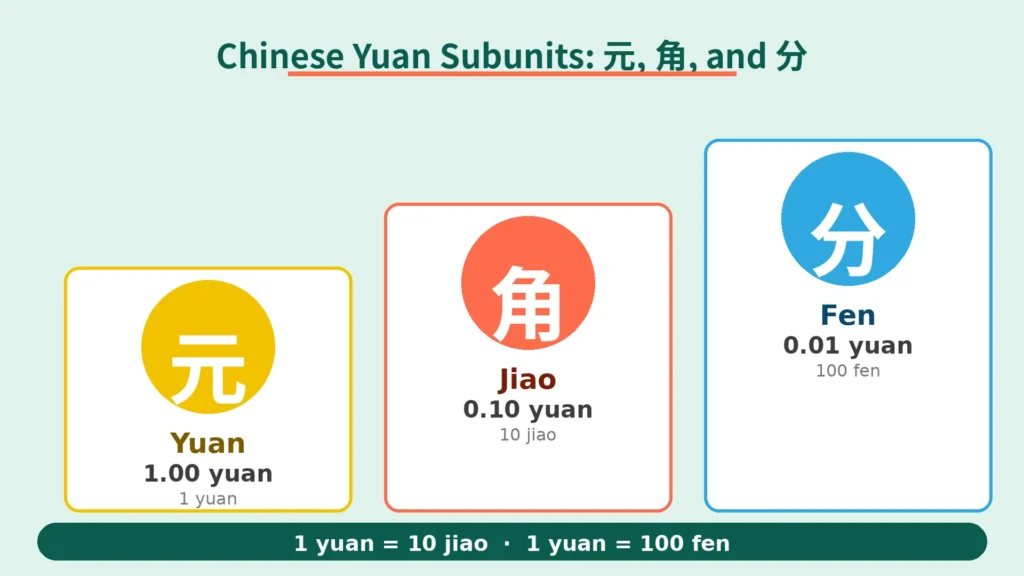
The Chinese yuan is divided into smaller monetary units. These subdivisions are useful when reading prices, accounting records, and exact currency amounts.
The basic relationship is:
- 1 yuan = 10 jiao.
- 1 jiao = 10 fen.
- 1 yuan = 100 fen.
| Chinese character | Pinyin | Meaning | Value in yuan |
|---|---|---|---|
| 元 | yuán | Yuan | 1.00 |
| 角 | jiǎo | Jiao | 0.10 |
| 分 | fēn | Fen | 0.01 |
These units explain how smaller fractions of a yuan are expressed in Chinese. Their appearance in daily cash transactions can vary, and fen is less prominent in some everyday payment contexts than it is in exact accounting or pricing.
What does 角 mean?
The character 角 represents one-tenth of a yuan.
For example, 5角 equals 0.5 yuan. A price of 3 yuan and 5 jiao totals 3.5 yuan.
You may encounter this unit in monetary explanations, formal writing, and descriptions of fractional amounts.
What does 分 mean?
The character 分 represents one-hundredth of a yuan when used as a monetary subdivision.
For example, 25分 equals 0.25 yuan. A price of 8 yuan and 25 fen totals 8.25 yuan.
Although the subdivision is part of the monetary system, you may not see fen used explicitly in every modern retail price. Some displays simply use decimal notation, such as ¥8.25.
What does 块 mean?
块 (kuài) is an informal Chinese word for yuan. It is common in spoken Mandarin and everyday conversation.
Examples:
- 10块 means 10 yuan.
- 50块 means 50 yuan.
- 100块 means 100 yuan.
The difference is mainly one of usage. 元 is the standard written unit character, while 块 is frequently used in informal speech.
What does 毛 mean?
毛 (máo) is an informal term for one-tenth of a yuan, equivalent to one jiao.
For example, someone might describe 5.5 yuan as five yuan and five mao in casual conversation.
Knowing 块 and 毛 can help you understand spoken Chinese, shopping conversations, and everyday references to money.
How to Write Chinese Yuan Amounts Correctly
Different websites, documents, and languages may display Chinese yuan amounts in different formats. Understanding the notation helps you recognize the value without mistaking the currency name for the currency symbol.
| Written amount | Meaning |
|---|---|
| ¥20 | 20 units of a currency represented by ¥; context is needed |
| CNY 20 | 20 Chinese yuan |
| 20元 | 20 yuan in Chinese writing |
| RMB 500 | 500 renminbi |
| CN¥299 | 299 Chinese yuan where this notation is used |
| 3元5角 | 3.5 yuan |
| 8元25分 | 8.25 yuan |
Should the symbol appear before or after the number?
In many international financial interfaces, the currency sign appears before the amount, as in ¥100. Chinese-language writing commonly places 元 after the number, as in 100元.
The correct format depends on the language and style of the document. Follow the convention used by the relevant organization or platform, especially in financial reports, contracts, and invoices.
How to avoid ambiguity in financial documents
For international business, use the three-letter currency code when the currency must be unmistakable.
For example, CNY 10,000 clearly identifies the amount as Chinese yuan. A bare ¥10,000 may be ambiguous if the document discusses both Chinese yuan and Japanese yen.
In a spreadsheet or accounting system, use a separate currency field or an explicitly labeled column when amounts from different currencies appear together.
This is particularly important when comparing supplier quotes, calculating revenue, preparing budgets, or recording international payments.
What Does � Mean in Chinese Yuan Symbols?
The string � is not a Chinese yuan symbol. It commonly appears when text containing an incorrectly decoded character is displayed using the wrong character encoding.
The distinction is important because the intended character might be ¥, but the displayed text alone does not prove that this was the original character.
Understanding the replacement character �
The character � is known as the Unicode replacement character, with code point U+FFFD. Software may use it when it encounters text that cannot be decoded correctly or when an original character cannot be preserved.
For example, imagine that a website contains a yuan symbol but its data-processing system mishandles the character. The page may display a replacement character instead of the intended symbol.
If that replacement character is then interpreted incorrectly by another system, it may appear as �.
This is an example of mojibake: text that appears garbled because of a mismatch in character encoding or decoding.
Is � always a corrupted yuan sign?
No. It may replace a yuan symbol, but it can also appear in text that originally contained an entirely different character.
For instance, if a document shows �100, the original amount might have been intended to display a currency sign, but you cannot confirm that it was ¥ based on the corrupted text alone.
The correct approach is to check the original website, document, database, or source file.
What is the difference between � and �?
| Displayed text | Explanation |
|---|---|
| ¥ | Common currency symbol used for Chinese yuan and Japanese yen |
| 元 | Chinese character for the yuan monetary unit |
| � | Unicode replacement character, U+FFFD |
| � | A sequence that can result from incorrectly decoding the replacement character |
| CNY | Standardized currency code for Chinese yuan |
These strings have different meanings and should not be substituted for one another without checking the intended text.
Why does a currency symbol become corrupted?
Several technical problems can cause a symbol to display incorrectly.
Incorrect character encoding: Text may be saved in one encoding and read using another.
Database problems: A database, import process, or connection may fail to preserve the original Unicode characters.
Copy-and-paste errors: Text can become corrupted when transferred between applications that interpret or transform it differently.
Incorrect website declarations: A page may declare a character set that does not match the actual data.
Repeated encoding conversions: Text that is repeatedly converted between incompatible encodings can become corrupted over multiple processing steps.
Data loss: If a character has already been replaced by U+FFFD and the original value was discarded, the exact original character may no longer be recoverable from the displayed text alone.
Understanding the cause is essential because simply changing the visible characters may hide the symptom without fixing the underlying problem.
How to Fix � Instead of the Chinese Yuan Symbol
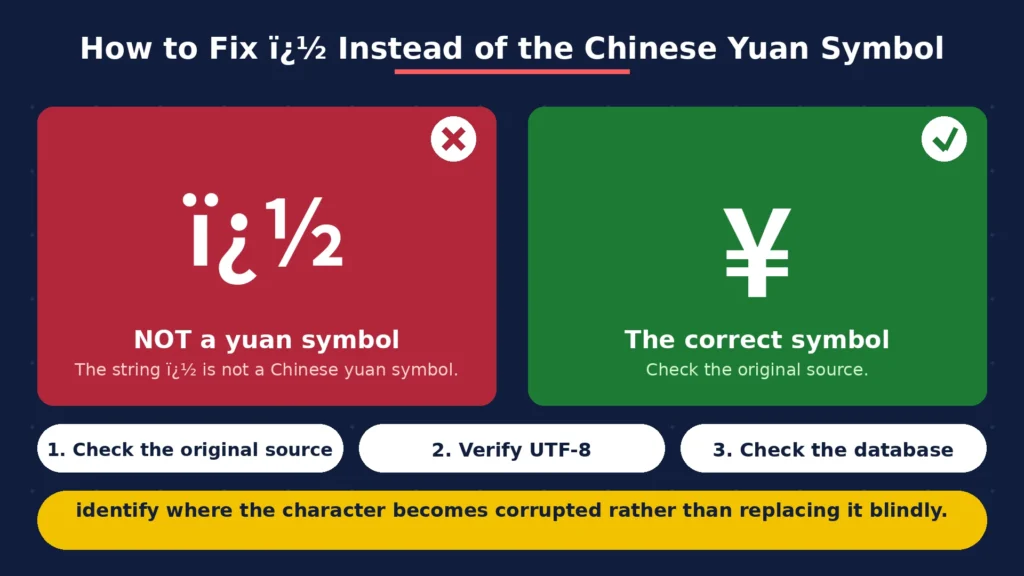
If you are a website owner, developer, editor, or someone working with spreadsheets, the best solution is to identify where the character becomes corrupted rather than replacing it blindly.
Check the original source
Start by comparing the corrupted text with the original document or website.
If the original source correctly displays ¥ but your exported file displays �, the problem may occur during export, import, or character decoding.
If the original source already contains �, the character may have been replaced before the text reached your current application.
Verify that UTF-8 is used consistently
UTF-8 is a widely supported Unicode encoding used by modern websites and applications.
For an HTML document, the character set can be declared using:
<meta charset="UTF-8">This tells the browser how the HTML document should be interpreted. However, the declaration cannot restore characters that were already lost or corrupted in an earlier processing step.
The server’s HTTP response, source file, database, and application should also handle the text consistently.
Check the database and import process
If a Chinese currency symbol becomes corrupted after importing a CSV file or saving a database record, inspect the entire data path.
- Confirm the source file’s actual encoding.
- Check the database’s character-set and column settings.
- Verify the encoding used by the database connection.
- Inspect the application’s import and export behavior.
- Compare the stored value with the value displayed by the website.
The exact fix depends on the database, programming language, framework, and file format involved.
Avoid blindly replacing � with ¥
A global find-and-replace operation can introduce new errors if the original character was not a yuan symbol.
For example, an article containing corrupted quotation marks, punctuation, or other characters could be damaged further if every occurrence of � is replaced with ¥.
Instead, verify the original content, repair the encoding issue where possible, and replace individual characters only when the intended text is known.
If the original character was already replaced by U+FFFD and no intact source exists, the missing character may need to be recovered from another copy or reconstructed from reliable context.
How to Type or Copy the Chinese Yuan Symbol
If you simply need the Chinese yuan sign for a blog post, product price, financial spreadsheet, or message, copying the character is usually the easiest method.
¥
Unicode: U+00A5 · HTML entity: ¥
Copy yuan symbol
You can also copy the Chinese unit character or currency abbreviation below.
元
Chinese yuan unit
Copy
人民币
Renminbi in Chinese
Copy
CNY
International currency code
Copy
How to type ¥ on Windows
The easiest method is to copy the symbol from this page. Alternatively, use Windows Character Map to find the yen sign and insert it into your document.
Keyboard shortcuts vary by keyboard layout, region, and application. If a shortcut produces a different character, use the Character Map utility or copy and paste the symbol directly.
How to type ¥ on a Mac
On macOS, the shortcut for the yen sign depends on the selected keyboard layout and input source.
You can use the Character Viewer to locate the character, or copy ¥ from this guide and paste it into your document.
If you work with currency symbols frequently, check your keyboard’s language settings so that you know which shortcuts are available in your configuration.
How to type Chinese yuan symbols on Android and iPhone
On a phone or tablet, you can usually:
- Copy ¥ from this page.
- Open the currency or symbols section of the on-screen keyboard.
- Switch to a Chinese input keyboard to enter characters such as 元 or 人民币.
The exact steps vary by keyboard application, operating system version, and language settings. Copying the symbol is a reliable alternative when you cannot find it on the keyboard.
Chinese Yuan Symbol in HTML and Programming
Web developers may need the yuan symbol when building online stores, price displays, currency converters, financial dashboards, and accounting applications.
The symbol ¥ has Unicode code point U+00A5. It can be represented directly as a character or by using HTML character references.
| Method | Code | Display |
|---|---|---|
| Literal character | ¥ | ¥ |
| HTML named entity | ¥ | ¥ |
| Decimal HTML entity | ¥ | ¥ |
| Hexadecimal HTML entity | ¥ | ¥ |
| Unicode notation | U+00A5 | U+00A5 |
These methods represent the same character. For standard HTML content, you can generally use the literal character in a correctly encoded UTF-8 document or an appropriate HTML entity.
Example of a Chinese yuan price in HTML
<!DOCTYPE html>
<html lang="en">
<head>
<meta charset="UTF-8">
<title>Chinese Yuan Price</title>
</head>
<body>
<p>Price: ¥299</p>
<p>Price: ¥299</p>
<p>Price: CNY 299</p>
</body>
</html>This example demonstrates three ways to present a price. The first two use the ¥ sign, while the third uses the currency code to identify Chinese yuan explicitly.
How to display yuan prices correctly on a website
A website should do more than render the correct character. It should also identify the correct currency.
For example, a product listing intended for Chinese yuan should not rely on an ambiguous ¥ sign if customers might confuse it with Japanese yen.
Consider these best practices:
- Use the correct currency code in the underlying data.
- Display a clear currency label when ambiguity is possible.
- Keep text encoding consistent across the server, database, and page.
- Test prices in the actual browsers and applications your visitors use.
- Verify that exported files preserve special characters.
For more complex financial applications, use a reliable currency-formatting library and store currency identifiers separately from formatted display strings. This makes it easier to support multiple currencies without relying on assumptions about the symbol.
Frequently Asked Questions About Chinese Yuan Symbols
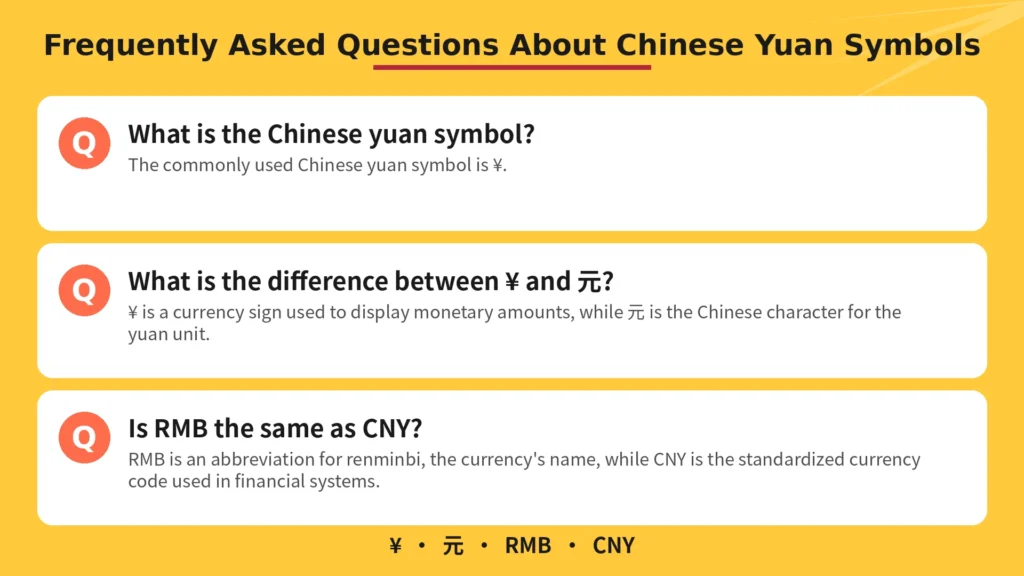
What is the Chinese yuan symbol?
The commonly used Chinese yuan symbol is ¥. The Chinese character 元 represents the yuan monetary unit. RMB is the abbreviation for renminbi, and CNY is the international currency code for Chinese yuan.
What does ¥ mean in Chinese money?
The symbol ¥ represents a monetary amount when the context identifies the currency. In China, it commonly represents yuan. However, Japan also uses ¥ for its currency, the yen, so the symbol alone may not identify the currency conclusively.
What is the difference between ¥ and 元?
¥ is a currency sign used to display monetary amounts, while 元 is the Chinese character for the yuan unit. For example, a Chinese price might be written as ¥100 or 100元.
Is RMB the same as CNY?
They refer to the same currency in ordinary mainland Chinese currency contexts, but they serve different purposes. RMB is an abbreviation for renminbi, the currency’s name, while CNY is the standardized currency code used in financial systems.
Why do Chinese yuan and Japanese yen have the same symbol?
Both currencies use ¥ as their commonly recognized symbol. Their official currency codes are different: CNY for Chinese yuan and JPY for Japanese yen. The currency code is the clearest way to distinguish them in international financial documents.
What does 元 mean in Chinese?
元 (yuán) is the Chinese character used for the yuan monetary unit. It commonly appears after a number, such as 50元, meaning 50 yuan.
What is the difference between 元, 圆, and 圓?
元 is the commonly used character for the yuan unit in modern mainland Chinese price displays. 圆 is the simplified form of 圓, and both are associated with the meaning “round” and historical monetary terminology. Their use depends on context, and they should not be treated as universally interchangeable.
What does � mean?
The string � is often associated with an encoding error. It can appear when the Unicode replacement character � is interpreted using the wrong encoding. It is not a Chinese yuan symbol, and the original character cannot always be identified from the corrupted text alone.
How do I fix � on a website?
Check the original source, verify the actual character encoding, inspect the server’s character-set declaration, and review database and import/export settings. If the original character has already been replaced by U+FFFD, you may need an intact source copy to recover it.
How do I copy the Chinese yuan symbol?
Copy this character and paste it into your document or message:
¥
For Chinese-language writing, you can also copy 元. If you need to identify the currency unambiguously in financial records, use CNY.
What are the Chinese yuan subunits?
One yuan equals 10 jiao, and one jiao equals 10 fen. The corresponding Chinese characters are 元, 角, and 分. These units help describe fractional yuan amounts in formal and everyday contexts.
Can I use the yuan symbol in HTML?
Yes. You can use the literal character ¥, the named HTML entity ¥, the decimal entity ¥, or the hexadecimal entity ¥. Make sure the document and its data are handled with a consistent character encoding.
Why does my Chinese yuan symbol look different on different devices?
Fonts, keyboard layouts, applications, and rendering systems can affect how a character appears. However, a normal font variation is different from corrupted text. If the symbol becomes � or �, check the character encoding and original data rather than assuming it is simply a font issue.
Final Thoughts
Chinese yuan symbols become much easier to understand once you distinguish the currency sign, the Chinese monetary unit, the currency name, and the international currency code.
- ¥ is the commonly used Chinese yuan symbol, although Japanese yen shares the same sign.
- 元 is the Chinese character for the yuan monetary unit.
- RMB stands for renminbi, the name of China’s currency.
- CNY is the standardized currency code for Chinese yuan.
- 角 and 分 represent smaller monetary units.
- � is not a yuan symbol; it may indicate a character-encoding problem.
For everyday use, you can copy ¥ directly from this article. For shopping, international payments, and financial reporting, confirm the currency code whenever the symbol could be ambiguous. If you encounter �, check the original source before replacing it with a currency sign.
Understanding these distinctions helps you read Chinese prices accurately, avoid confusion between yuan and yen, and resolve common problems involving special characters on websites and in documents.
Related Articles
- Number Symbols: Copy and Paste ① ② ③, Names, and Meanings
- On Off Symbols: What I, O, ⏻ and Power Button Symbols Mean
- Gender Symbols ♀ ♂ ⚧: Complete Meanings, History, Types, Unicode & Copy-Paste Guide

I’m Amelia Richardson, a language writer who enjoys discovering the meaning behind words, phrases, and expressions. I believe good language content should be simple, accurate, and useful in real situations. At Meanera, I write easy-to-follow explanations that help readers understand everything from common vocabulary to modern slang.
Books:
- A Journey Through English Words
- Expressions Made Easy
 Grace Harrison
 Lucas Thompson