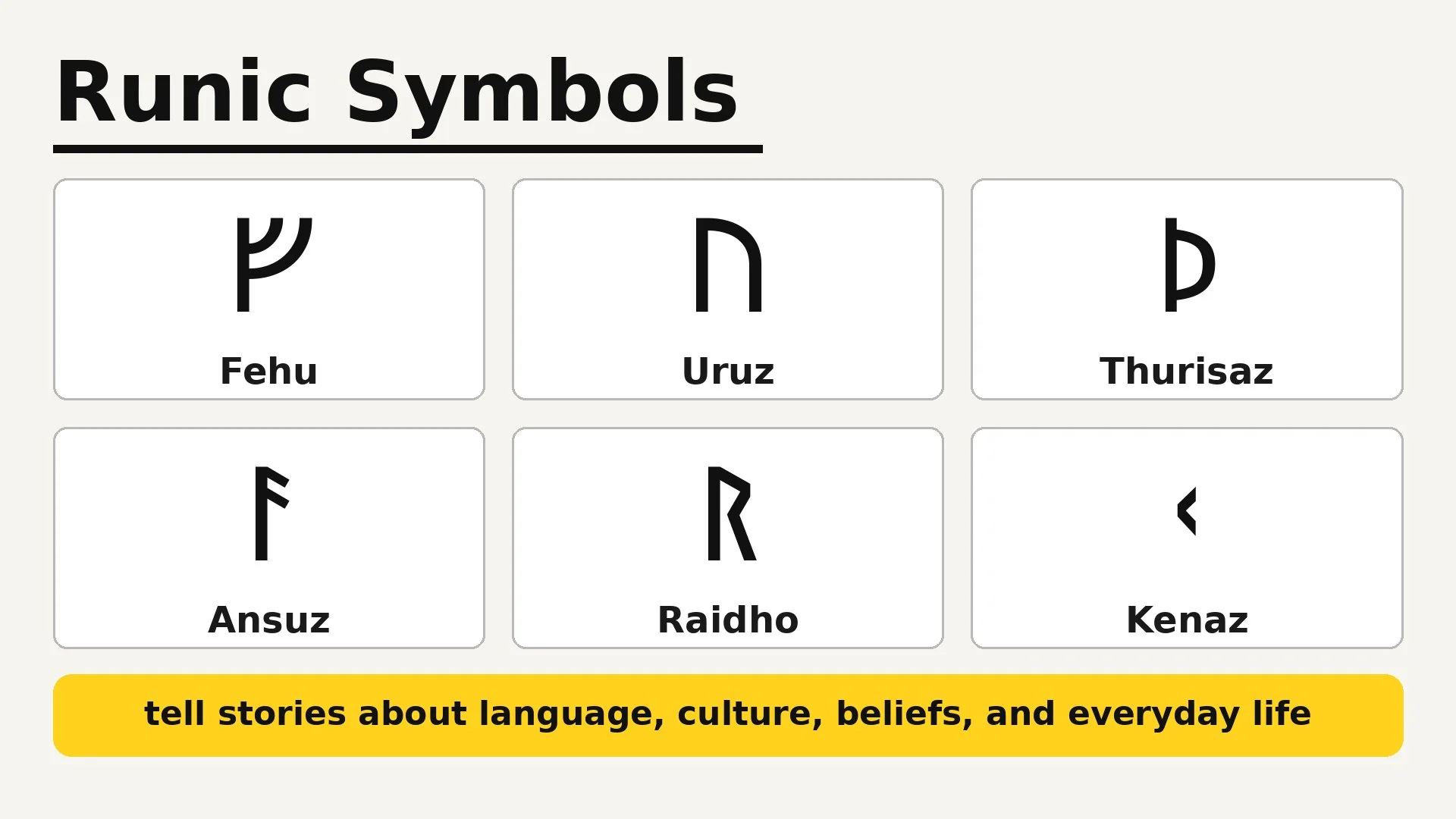
Runic symbols are ancient characters that tell stories about language, culture, beliefs, and everyday life in northern Europe. Often associated with Vikings and Norse mythology, these distinctive symbols have attracted renewed interest among people researching ancient history, choosing meaningful tattoos, exploring spiritual traditions, or learning how to write names using runes.
But what do runic symbols really mean? Some represent sounds in an alphabet, while their names may be connected with concepts such as wealth, ice, gifts, the sun, or human beings. Other meanings commonly found online come from modern spiritual interpretations rather than direct historical evidence.
Understanding this difference is essential if you want to learn the authentic history of runes without overlooking their modern symbolic significance.
This complete guide explains the major runic alphabets, the meanings of all 24 Elder Futhark runes, Viking-Age runes, popular Norse symbols, protective and prosperity-related interpretations, rune tattoos, pronunciation, transliteration, and frequently asked questions. It also separates documented historical facts from interpretations that remain uncertain.
What Are Runic Symbols?
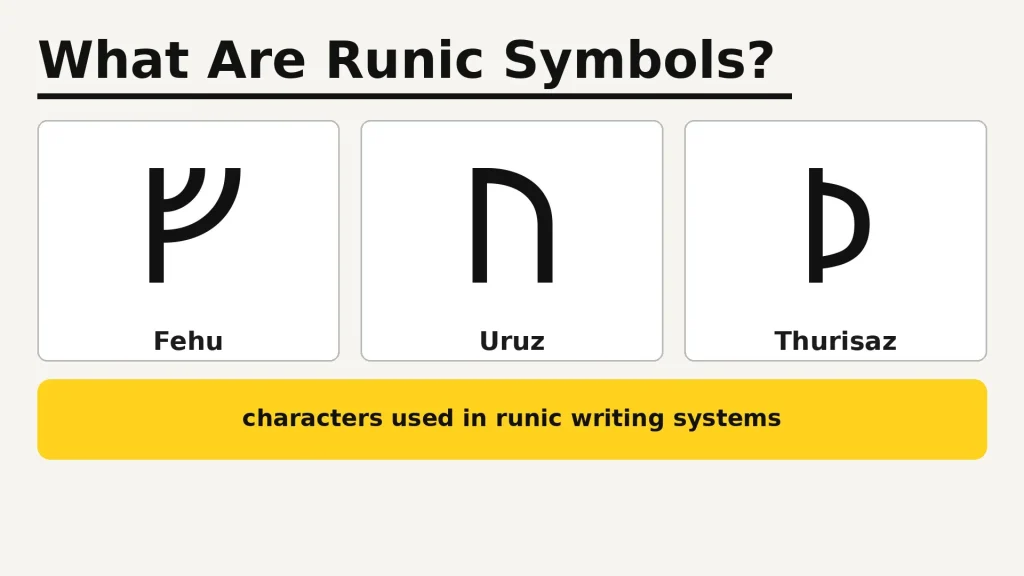
Runic symbols are characters used in runic writing systems developed among Germanic-speaking peoples during the early centuries CE. These writing systems were used across northern and parts of central Europe, and their forms changed over time.
The earliest surviving runic inscriptions date to approximately the second century CE. Runes were carved into objects such as combs, weapons, jewelry, stone monuments, and wooden pieces. Many inscriptions recorded personal names, ownership, makers, memorials, or short messages. Some objects and texts also suggest ritual or magical uses.
Unlike decorative pictures, runes primarily functioned as letters. Each character represented a sound or a range of sounds in the language being written.
What Does the Word Rune Mean?
The word rune is associated with an old Germanic word family connected with secrets, mysteries, or whispered knowledge. This association helps explain why runes often appear mysterious in modern culture.
However, the word’s association with secrecy does not mean that every rune was a magical sign. Most surviving runic evidence concerns writing, communication, identification, commemoration, or marking objects.
What Do Runic Symbols Represent?
A rune can be understood in several different ways.
- As a letter: It represents a sound in a particular runic alphabet.
- Through its name: Some rune names are associated with words such as cattle, ice, sun, or gift.
- Through historical context: Its meaning in an inscription depends on the language, surrounding characters, object, and period.
- Through mythology: Some symbols and rune names have connections with Germanic or Norse traditions.
- Through modern spirituality: Contemporary practitioners may use runes to represent protection, strength, love, prosperity, or personal development.
These interpretations should remain separate. For example, a rune associated with cattle or wealth through its traditional name may be interpreted as prosperity in modern spiritual practice, but this does not prove that the character automatically attracts money.
The Main Runic Alphabets Explained
There is no single runic alphabet covering every period of Germanic and Scandinavian history. Three major systems are especially important: Elder Futhark, Younger Futhark, and Anglo-Saxon Futhorc.
24
Characters
Elder Futhark
Approximately 2nd–8th centuries CE
The oldest major runic alphabet, used by early Germanic-speaking communities. It is the principal alphabet discussed in modern guides to the 24 runes.
16
Characters
Younger Futhark
Viking Age, approximately 8th–12th centuries
The reduced runic alphabet used in Viking-Age Scandinavia. Its characters could represent multiple sounds, so interpreting inscriptions requires attention to context.
28–33
Common range
Anglo-Saxon Futhorc
Used in early England and expanded to represent the sounds of Old English. Its character count varied across different stages and forms of the writing system.
The University of Copenhagen’s runology overview distinguishes the older 24-character Futhark, the Viking-Age 16-character Futhark, and medieval developments of the runic script.
Elder Futhark: The 24-Character Alphabet
Elder Futhark is often the starting point for people searching for runic symbols and their meanings. Its name comes from the first six characters of the sequence: F, U, Þ, A, R, and K.
The 24 characters are often arranged in three groups of eight called ættir in modern discussions of the alphabet.
An important historical detail is that the familiar names of the Elder Futhark runes are generally reconstructed using later Germanic evidence. They were not all directly recorded in surviving texts from the period when Elder Futhark was in use. Therefore, a traditional name or modern symbolic interpretation should not automatically be treated as a complete, proven ancient definition.
Younger Futhark: The Viking Runic Alphabet
The Younger Futhark developed around the beginning of the Viking Age and became the main runic writing system in Scandinavia during that period.
It contains 16 characters rather than 24. This does not mean it was an incomplete version of Elder Futhark. It was a different system adapted to the changing writing practices and language of its users.
Because it had fewer characters than the language had sounds, one rune could represent more than one sound. A rune used for t, for example, could also represent d, while a rune used for k could also represent g. These overlaps can make historical inscriptions challenging to interpret.
Anglo-Saxon Futhorc: Runes Used in Early England
Anglo-Saxon Futhorc developed from the older runic tradition and expanded to accommodate sounds found in early English.
Its inscriptions provide evidence of how runic writing adapted to different languages and cultural environments. This is another reason not to treat all runes as exclusively Viking or exclusively Norse.
Elder Futhark Rune Symbols and Meanings: Complete Reference Chart
The following chart covers all 24 Elder Futhark characters. It distinguishes their conventional reconstructed names and linguistic associations from common modern symbolic meanings.
The modern interpretations are included because they are widely sought by readers interested in spiritual symbolism, jewelry, and tattoos. They should not be mistaken for a universally established ancient system of meanings.
| Rune | Name | Traditional association | Common modern interpretation |
|---|---|---|---|
| ᚠ | Fehu | Cattle, movable wealth | Prosperity, resources, responsibility |
| ᚢ | Uruz | Aurochs, wild ox | Strength, endurance, vitality |
| ᚦ | Thurisaz | Giant or threatening force | Boundaries, defense, challenges |
| ᚨ | Ansuz | Traditionally connected with a deity or divine authority | Communication, wisdom, inspiration |
| ᚱ | Raidho | Riding or journey | Direction, travel, progress |
| ᚲ | Kenaz | Torch or related light imagery; interpretation debated | Creativity, knowledge, illumination |
| ᚷ | Gebo | Gift | Generosity, exchange, partnership |
| ᚹ | Wunjo | Joy or well-being | Happiness, harmony, satisfaction |
| ᚺ | Hagalaz | Hail | Disruption, change, adaptation |
| ᚾ | Nauthiz | Need or necessity | Patience, endurance, discipline |
| ᛁ | Isa | Ice | Stillness, restraint, focus |
| ᛃ | Jera | Year or annual cycle | Harvest, timing, results of effort |
| ᛇ | Eihwaz | Traditionally associated with yew | Resilience, endurance, transition |
| ᛈ | Perthro | Original meaning disputed | Mystery, uncertainty, possibility |
| ᛉ | Algiz | Name and original interpretation debated | Protection, awareness, boundaries |
| ᛊ | Sowilo | Sun | Energy, clarity, achievement |
| ᛏ | Tiwaz | Associated with Týr | Courage, justice, duty |
| ᛒ | Berkano | Birch | Growth, renewal, nurturing |
| ᛖ | Ehwaz | Horse | Trust, movement, cooperation |
| ᛗ | Mannaz | Human being | Identity, community, self-awareness |
| ᛚ | Laguz | Water or a related body of water | Adaptability, flow, intuition |
| ᛜ | Ingwaz | Associated with Ing or Yngvi | Potential, development, fertility |
| ᛞ | Dagaz | Day | Clarity, awakening, transformation |
| ᛟ | Othala | Inherited property or ancestral estate | Heritage, belonging, family history |
How to read this chart: The rune character is the written sign. The name is a conventional or reconstructed designation. The traditional association describes the name or its linguistic background, while the final column gives contemporary interpretations rather than guaranteed historical meanings.
The First Eight Runes: Fehu to Wunjo
The first group contains several runes that modern guides associate with resources, strength, communication, movement, creativity, relationships, and happiness.
Fehu (ᚠ): Wealth and resources
Fehu is associated with cattle and movable wealth. In societies where livestock represented economic value, wealth could include animals and other productive resources rather than money alone.
Modern interpretations connect Fehu with prosperity, opportunity, financial responsibility, and the management of resources. As a personal symbol, it can remind someone to consider how they earn, use, protect, and share what they possess.
Uruz (ᚢ): Strength and endurance
Uruz is traditionally associated with the aurochs, an extinct wild type of cattle. Contemporary interpretations connect it with physical vitality, resilience, courage, and determination.
People may choose Uruz as a reminder to develop strength through consistent effort. Its modern association with endurance is an interpretation based partly on its traditional name, not proof of a universal ancient spiritual function.
Thurisaz (ᚦ): Challenges and boundaries
Thurisaz is commonly connected with a giant or threatening force in related Germanic traditions. Modern guides often interpret it through danger, defense, resistance, and personal boundaries.
It can symbolize the need to pause and think carefully before responding to a difficult situation. Its contemporary association with protection should not be confused with evidence that the rune always functioned as a protective charm.
Ansuz (ᚨ): Communication and wisdom
Ansuz is often linked in modern interpretations with communication, knowledge, inspiration, and divine authority. It is a popular choice for people interested in learning, speaking, writing, or creative expression.
Its historical linguistic development is more complicated than a single simple definition. It is therefore better to describe wisdom and communication as common modern associations than to claim that every ancient inscription containing the rune expressed those ideas.
Raidho (ᚱ): Journey and direction
Raidho is associated with riding or a journey. Its contemporary meanings include travel, progress, discipline, and direction.
As a personal symbol, Raidho can represent moving toward a goal while paying attention to the choices made along the way. It is particularly suitable for modern designs intended to commemorate a journey or a period of personal change.
Kenaz (ᚲ): Knowledge and creativity
Kenaz is often interpreted as a torch or a source of illumination, although the reconstruction of its historical name has been debated.
Modern symbolism connects it with creativity, learning, discovery, and understanding. A person may use it as a reminder to develop a skill, explore an idea, or approach a problem from a new perspective.
Gebo (ᚷ): Gifts and partnership
Gebo is associated with a gift. Modern interpretations emphasize generosity, mutual support, exchange, and relationships.
It can represent the idea that healthy partnerships involve both giving and receiving. This makes Gebo a popular modern choice for relationship-themed jewelry and symbolic designs, although it is not a historical guarantee of romantic success.
Wunjo (ᚹ): Joy and harmony
Wunjo is associated with joy or well-being. Its modern interpretations include happiness, friendship, belonging, and satisfaction.
As a contemporary symbol, Wunjo can remind someone to value supportive relationships and everyday achievements rather than measuring life entirely through status or material success.
The Second Eight Runes: Hagalaz to Sowilo
The second group is often interpreted through ideas of difficulty, necessity, stillness, seasonal cycles, endurance, uncertainty, awareness, and sunlight.
Hagalaz (ᚺ): Disruption and change
Hagalaz is associated with hail, which can damage crops and disrupt ordinary life. Modern interpretations connect it with sudden change, uncertainty, and circumstances beyond personal control.
Rather than viewing it only as a negative symbol, contemporary users may interpret Hagalaz as a reminder to adapt when plans change.
Nauthiz (ᚾ): Need and patience
Nauthiz is associated with need or necessity. Modern interpretations emphasize discipline, perseverance, limitations, and the ability to identify what matters most.
It can serve as a reminder that achieving a goal sometimes requires patience and practical decisions instead of immediate results.
Isa (ᛁ): Stillness and focus
Isa is associated with ice. Its contemporary meanings include concentration, restraint, stillness, and a pause before action.
Isa can represent the value of waiting until a situation becomes clearer before making a decision. This is a modern metaphor rather than a prediction that progress must stop.
Jera (ᛃ): Harvest and timing
Jera is associated with the year or annual cycle and is commonly interpreted through the idea of harvest.
Its modern symbolism includes the results of sustained effort, patience, timing, and seasonal change. It can serve as a reminder that meaningful results often require preparation and time.
Eihwaz (ᛇ): Resilience and endurance
Eihwaz is traditionally associated with the yew tree. Modern interpretations connect it with resilience, endurance, protection, and transition.
Its precise historical symbolic meaning is not established as clearly as a simple one-word definition might suggest. Treat detailed spiritual associations as interpretations rather than settled historical facts.
Perthro (ᛈ): Mystery and uncertainty
Perthro is one of the most disputed Elder Futhark rune names. Its original meaning remains uncertain, and modern guides propose a variety of interpretations.
Some contemporary practices associate it with mystery, hidden information, chance, or possibilities that have not yet become clear. These ideas may be useful within a modern symbolic system, but they should not be presented as a universally accepted ancient definition.
Algiz (ᛉ): Awareness and protection
Algiz is widely associated with protection in modern rune guides, although its historical name and original interpretation are debated.
As a contemporary symbol, it can represent awareness, defense, and personal boundaries. Claims that Algiz automatically prevents harm are matters of spiritual belief rather than established evidence.
Sowilo (ᛊ): Sun and energy
Sowilo is associated with the sun. Modern interpretations often connect it with vitality, clarity, optimism, and achievement.
It can serve as a personal reminder to seek clarity and use energy constructively. Its association with the sun is more securely grounded in its traditional name than many detailed predictions found in modern rune readings.
The Third Eight Runes: Tiwaz to Othala
The final group includes runes traditionally associated with a deity, plants, animals, humanity, water, ancestry, and the cycle of day.
Tiwaz (ᛏ): Courage and justice
Tiwaz is associated with Týr, a deity in Germanic and Norse traditions. Modern interpretations connect the rune with courage, fairness, responsibility, and principled action.
It can symbolize the willingness to accept responsibility for decisions and to act according to one’s values.
Berkano (ᛒ): Growth and renewal
Berkano is associated with birch. Its modern symbolic meanings include renewal, growth, nurturing, and new beginnings.
It is often chosen to represent personal development, the start of a new project, or the process of building something over time.
Ehwaz (ᛖ): Trust and cooperation
Ehwaz is associated with a horse. Modern interpretations emphasize movement, teamwork, loyalty, and mutual trust.
It can represent progress achieved through cooperation rather than individual effort alone.
Mannaz (ᛗ): Humanity and identity
Mannaz is associated with a human being. Its contemporary interpretations include self-awareness, identity, community, and social responsibility.
As a symbolic reminder, it can encourage people to consider how their decisions affect both themselves and others.
Laguz (ᛚ): Water and adaptability
Laguz is associated with water. Modern interpretations frequently connect it with intuition, emotional awareness, flexibility, and the ability to adapt.
Water offers a useful metaphor for navigating change, but the symbolic association should not be confused with a proven ancient interpretation of every inscription containing the rune.
Ingwaz (ᛜ): Potential and development
Ingwaz is associated with Ing or Yngvi in related traditions. Modern rune guides often connect it with fertility, potential, preparation, and development.
It may represent a plan or ambition that is growing before its results become visible. Detailed claims about its spiritual effects remain interpretive.
Dagaz (ᛞ): Day and transformation
Dagaz is associated with day. Modern interpretations connect it with clarity, awakening, new perspectives, and transformation.
It can symbolize a moment when understanding improves or a person begins to see a familiar situation differently.
Othala (ᛟ): Heritage and ancestral property
Othala is associated with inherited property or an ancestral estate. Modern interpretations often emphasize family history, heritage, belonging, and cultural roots.
This rune requires attention to context because its form has also been appropriated by extremist movements. Its historical use is not identical to those later political associations, but people choosing it for a tattoo or public display should research the full design and its contemporary context.
Viking Runic Symbols: What Did Vikings Actually Use?
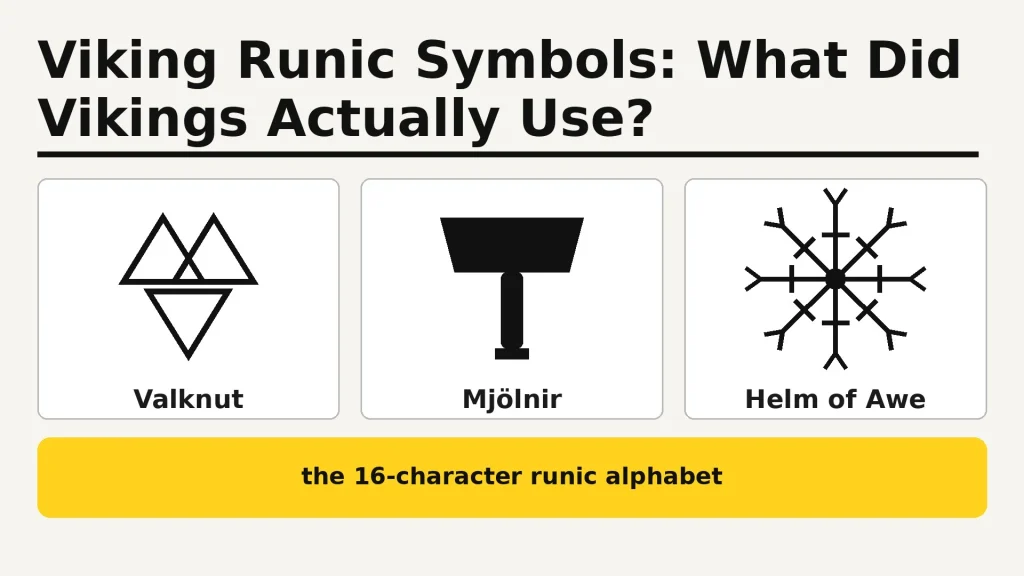
Viking runes are among the most searched forms of runic symbolism, but popular articles sometimes mix different historical periods into one category. Understanding the difference between Viking-Age runes and other Norse symbols helps prevent confusion.
The Younger Futhark and Viking-Age Writing
During the Viking Age, Scandinavians commonly used Younger Futhark, the 16-character runic alphabet. Runes were carved on stones and smaller objects, including combs, weapons, and personal belongings. Many inscriptions recorded names, ownership, memorials, or the person who made an object.
Runes were not simply magical decorations. They were a practical writing system, although some inscriptions and objects also suggest ritual or magical uses.
The Valknut
The Valknut is a design formed from three interlocking triangles. It appears in discussions of Norse mythology and is often associated in modern interpretations with Odin, death, warriors, or the afterlife.
However, the symbol’s original name and exact meaning are uncertain. It is not a rune in either Elder or Younger Futhark. If you are researching it, treat it as a separate Norse-associated symbol rather than a letter in the runic alphabet.
Mjölnir: Thor’s Hammer
Mjölnir is the hammer belonging to Thor in Norse mythology. Hammer-shaped pendants have been found in Viking-Age archaeological contexts and are commonly interpreted as representations of Thor’s hammer.
Today, Mjölnir is associated with Thor, strength, protection, and Norse cultural identity. It is a mythological object represented by a separate symbol, not a runic character.
The Helm of Awe
The Helm of Awe, commonly known as Ægishjálmur, is associated with later Icelandic magical traditions. It is often represented by a radial pattern with arms extending from a central point.
Modern interpretations frequently associate it with protection, courage, and the ability to face fear. Its documented context should not be confused with the evidence for Viking-Age runic writing.
The Vegvísir
The Vegvísir is another symbol popular in modern Norse-inspired designs. It is commonly described as a symbol of guidance or wayfinding.
Its documented history belongs to later Icelandic magical manuscript traditions rather than securely established Viking-Age practice. Although the symbol is often used in modern Viking-themed tattoos, it should not automatically be described as an ancient Viking rune.
Runes and Norse Symbols: The Main Difference
| Symbol or system | What it is | Historical context |
|---|---|---|
| Elder Futhark | A 24-character runic alphabet | Early Germanic writing |
| Younger Futhark | A 16-character runic alphabet | Viking-Age Scandinavia |
| Valknut | A geometric symbol | Archaeological and Norse-associated contexts; exact meaning disputed |
| Mjölnir | Thor's hammer | Norse mythology and Viking-Age hammer pendants |
| Helm of Awe | A magical symbol | Later Icelandic magical traditions |
| Vegvísir | A wayfinding or guidance symbol in modern interpretations | Later Icelandic manuscript tradition |
This distinction is particularly useful when researching Viking tattoos, because a design may combine genuine historical writing with separate symbols or modern artistic interpretations.
Runic Symbols for Protection, Love, Wealth, and Good Luck
Many people searching for runic symbols are interested in their modern spiritual meanings. They may want a rune representing protection, romantic love, financial prosperity, courage, or positive change.
These interpretations can be discussed meaningfully as contemporary symbolism. However, no reliable scientific evidence establishes that a rune automatically attracts wealth, prevents danger, changes another person’s feelings, or predicts future events.
Which Rune Represents Protection?
Algiz is frequently associated with protection in contemporary rune guides. Thurisaz is also sometimes interpreted through themes of defense, danger, and boundaries.
The distinction is important: Algiz has a disputed historical interpretation, and Thurisaz’s association with a threatening force does not establish that either character served as a universal protective charm.
If you choose a protection rune for a personal object, consider it a reminder of awareness, caution, and personal boundaries rather than a guarantee of safety.
Which Rune Represents Love?
Gebo is a popular modern choice for relationships because its name is associated with a gift. Contemporary interpretations extend this association to generosity, mutual respect, and balanced partnerships.
For a relationship-themed design, Gebo can represent the importance of giving and receiving. It should not be presented as a historical spell that guarantees romantic attraction or causes a particular person to return.
Which Rune Represents Wealth and Prosperity?
Fehu is commonly connected with cattle and movable wealth. In modern symbolic interpretations, it represents prosperity, resources, financial goals, and responsible management.
Jera is another relevant choice because it is associated with the annual cycle and harvest. Its modern interpretation emphasizes the results of sustained work and the importance of timing.
For someone creating a personal symbol, Fehu can represent resourcefulness, while Jera can symbolize patience and long-term effort. Neither rune has a scientifically established ability to attract money.
Which Rune Represents Strength and Courage?
Uruz is often selected for strength, endurance, and vitality. Tiwaz is associated in modern interpretations with courage, duty, and principled action.
They offer different symbolic emphases: Uruz focuses on resilience, while Tiwaz is often used to represent standing by one’s values.
Which Rune Represents Good Luck?
There is no single historically or scientifically established rune that guarantees good luck.
Modern guides may associate Fehu with prosperity, Wunjo with happiness, and Sowilo with energy or success. These associations vary across contemporary traditions and should be treated as symbolic interpretations rather than reliable predictions.
A Quick Guide to Choosing a Rune by Intention
| Intention | Common modern choice | Idea it may represent |
|---|---|---|
| Protection | Algiz | Awareness and boundaries |
| Love and partnership | Gebo | Mutual giving and receiving |
| Wealth | Fehu | Resources and responsibility |
| Strength | Uruz | Endurance and vitality |
| Courage and justice | Tiwaz | Principled action |
| Happiness | Wunjo | Joy and harmony |
| Personal growth | Berkano | Renewal and development |
| Patience | Jera | Long-term effort |
| Wisdom and communication | Ansuz | Learning and expression |
| New perspective | Dagaz | Clarity and transformation |
Use these as a guide to contemporary symbolism, not as a definitive statement of what every historical rune meant.
Runic Symbols in Spirituality and Divination
Some contemporary practitioners use runes for divination, meditation, personal reflection, or spiritual rituals. A typical practice involves selecting one or more rune tokens and interpreting them in relation to a question.
This is different from historical runic literacy. The fact that people used runes in ancient writing does not establish that modern rune-casting methods were practiced in the same form during the Viking Age.
How Modern Rune Readings Work
A modern rune reading often involves a few basic steps.
- Choose a question: Identify a subject for reflection, such as a career decision, a relationship, or a personal goal.
- Draw one or more runes: Some people select a single character, while others use several runes in a spread.
- Interpret the symbols: The reader uses the rune names, traditional associations, and a chosen modern interpretive system.
- Reflect on the situation: The reading becomes a prompt to consider feelings, options, and possible actions.
Some systems also interpret a rune differently when it appears upside down. These are called reversed runes. Such interpretations vary by practice and should not be confused with an established rule shared by all historical runic traditions.
What Is the Blank Rune?
Some modern rune-divination sets contain a blank tile, sometimes described as the “blank rune” or associated with the unknowable.
It is important to understand that the blank rune is not a character in the historical 24-rune Elder Futhark. It became popular in modern rune-divination literature, particularly in the late twentieth century. It should therefore be described as a modern convention rather than an ancient runic letter.
Are Rune Readings Accurate?
There is no reliable scientific evidence that rune divination can predict the future through supernatural means. Some people nevertheless find it useful for reflection, exploring personal concerns, or expressing spiritual beliefs.
A responsible approach is to use rune readings as a reflective practice rather than as a replacement for evidence-based decisions, medical care, financial planning, or professional advice.
Runic Symbols for Tattoos and Jewelry
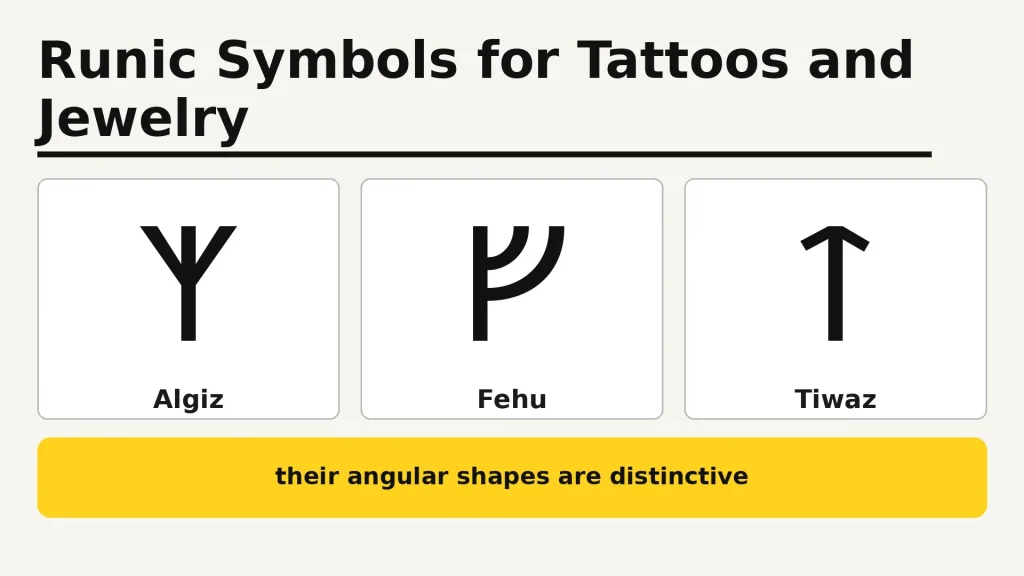
Runes are popular in tattoos, necklaces, rings, bracelets, and other personal designs because their angular shapes are distinctive and their historical associations are rich.
However, a design that looks attractive may not communicate what its wearer intends. Choosing the correct alphabet, spelling, and historical context is particularly important if you want a name, phrase, or meaningful concept represented accurately.
How to Choose a Rune Tattoo
Understand the character. Check whether the design uses Elder Futhark, Younger Futhark, or another runic system. Similar-looking characters may have different functions in different alphabets.
Research the meaning. Distinguish the rune’s sound value and traditional name from its modern spiritual interpretation. This is especially important for runes whose historical names or meanings remain disputed.
Check the spelling. A name or phrase must be transliterated according to the relevant language and writing system. Simply replacing every English letter with a rune may produce an inaccurate result.
Review the complete design. A bindrune combines two or more runic characters into one design. Modern artists may create these for personal or decorative purposes, but not every contemporary bindrune has a documented ancient origin.
Consider modern associations. Some runes and rune-like symbols have been appropriated by extremist movements. Research the full design and context before using a symbol publicly.
What Are Bindrunes?
A bindrune is a design that combines two or more runic characters, often by sharing or overlapping strokes. Such designs can be used for artistic, commemorative, or contemporary spiritual purposes.
Runes were combined in historical writing practices, but the specific conventions of modern bindrune design should not automatically be treated as an ancient standardized system. If historical accuracy matters, verify the origin of the particular design rather than relying on a general claim that all bindrunes are Viking symbols.
Can You Combine Runes for a Personal Meaning?
Yes, modern artists and practitioners sometimes combine runes to express a personal idea. The key is to be transparent about whether the result is a historical inscription, a phonetic spelling, or a contemporary symbolic composition.
For a permanent tattoo, have the spelling and character choices reviewed by someone familiar with the relevant runic alphabet and historical language. This is especially important for longer phrases, because transliteration depends on sounds and historical conventions rather than simple English-letter substitution.
How to Read, Pronounce, and Write Runic Symbols
Learning runes begins with understanding their alphabet and the language being written. The same character should not automatically be assigned one English letter in every historical context.
Learn the Rune Sounds First
A rune is primarily a writing character, not a complete word or an abstract spiritual concept.
For example, in Elder Futhark:
- ᚠ is commonly transliterated as f.
- ᚦ is transliterated as þ, representing a sound similar to the th in “think.”
- ᚱ is transliterated as r.
- ᛗ is transliterated as m.
- ᛊ is transliterated as s.
These are transliterations, not complete pronunciation guides for every language or period. The precise sounds represented by a character depend on the historical writing system.
Why Rune Transliteration Is Not Always One-to-One
Modern English uses letters and spelling conventions that developed in a different linguistic context from the early runic alphabets.
Younger Futhark makes this especially clear. Its 16 characters represented more sounds than there were individual runes. Consequently, one character could stand for several sounds, and a reader often needs the language and context to interpret an inscription correctly.
This means there is not always one uniquely correct way to convert a modern English name into runes. Different methods may be appropriate depending on whether the goal is historical accuracy, phonetic approximation, or a modern decorative design.
A Practical Example of Transliteration
Suppose you want to represent a modern name in runes. Begin by identifying how the name is pronounced, then decide which runic alphabet is appropriate.
Next, map the sounds to characters according to the selected system. Do not assume that every modern English letter has a matching rune. Some sounds may require an approximation, and a historically accurate rendering may differ from a modern decorative transliteration.
Finally, ask someone knowledgeable in runology to review the result if it will be used in a permanent tattoo or formal historical project.
How to Read a Runestone
Runestones often contain inscriptions commemorating deceased relatives or recording who commissioned or carved the stone. Some inscriptions also refer to journeys, social relationships, religious beliefs, or other events.
To interpret a runestone, researchers first identify the runic characters, then transliterate them, determine the language, and translate the text. The physical condition of the inscription, spelling conventions, and historical context all affect the result.
The Swedish History Museum notes that even when individual runes can be identified, an inscription may remain difficult to understand because the language and writing practices have changed over time.
Historical Evidence: What Actual Runic Inscriptions Tell Us
A useful runic-symbol guide should do more than list meanings. Real inscriptions help explain how people used runes and why context matters.
Runes on Everyday Objects
Archaeologists have found runic inscriptions on combs, weapons, jewelry, coins, and other personal belongings. Some identify an owner or maker; others preserve a name or short message.
The Swedish History Museum describes early inscriptions that include personal names and references to the people who created or owned objects. This evidence shows that runes had practical social uses long before their modern popularity in tattoos and spiritual symbolism.
Viking-Age Memorial Stones
Many famous Scandinavian runic inscriptions appear on stones raised in memory of deceased relatives. These memorials can record family relationships, achievements, journeys, and the people responsible for raising the stone.
Their messages are often more informative than a generic symbolic definition because they show how runes functioned in real language and social life.
A rune on a memorial stone is generally part of a word or sentence. It should not be assigned a modern spiritual meaning simply because it appears in a context that feels ceremonial.
What Historical Evidence Cannot Always Tell Us
The surviving record is incomplete. Wood and bark, which were important writing materials, can decay, leaving an uneven archaeological picture of how frequently runes were used.
Some inscriptions are damaged or too short to interpret confidently. Researchers may disagree about a reading, a name, or the meaning of a word. Reliable explanations should acknowledge uncertainty instead of filling gaps with unsupported claims.
This is especially important when discussing ritual use. An inscription interpreted as a charm can support a specific claim about that object, but it does not prove that every rune had a fixed magical power.
Common Misconceptions About Runic Symbols
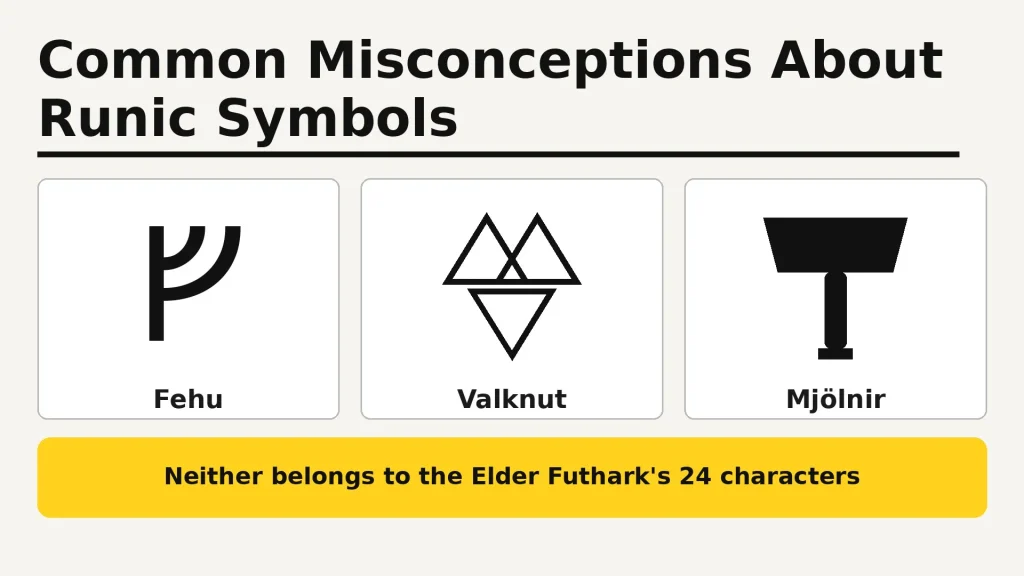
Every Rune Has One Fixed Spiritual Meaning
Runes were characters in writing systems. Their historical functions depended on the language, period, and inscription.
Modern rune guides often assign one-word symbolic meanings to each character. These can be useful within contemporary interpretive systems, but they are not all independently verified ancient definitions.
All Runes Are Viking Symbols
The runic tradition is older and broader than the Viking Age. Elder Futhark belongs to an earlier period of Germanic writing, and Anglo-Saxon Futhorc developed in a different linguistic environment.
Younger Futhark is the alphabet most closely associated with Viking-Age Scandinavia.
Runes Were Used Only for Magic
Historical evidence demonstrates ordinary uses such as recording names, marking possessions, and commemorating the dead. Some objects and inscriptions suggest ritual or magical uses, but those uses do not define every rune or every runic inscription.
The Valknut and Mjölnir Are Runic Letters
The Valknut is a separate geometric symbol, and Mjölnir represents Thor’s hammer. Neither belongs to the Elder Futhark’s 24 characters.
They may appear alongside runes in modern Norse-inspired artwork, but combining them in a design does not make them part of the runic alphabet.
Modern Rune Meanings Are All Historically Proven
Many contemporary interpretations draw on reconstructed rune names, later rune poems, mythology, and modern spiritual practice. These sources do not all provide the same type or level of evidence.
A reliable guide identifies which details are historical, which are reconstructed, and which represent modern beliefs.
When using any source, check whether it discusses the historical alphabet, a particular inscription, a reconstructed name, or a modern spiritual interpretation. That distinction will help you assess the reliability of the information.
Frequently Asked Questions About Runic Symbols
What Is the Most Powerful Rune?
There is no historically or scientifically established ranking of runes by supernatural power. Modern traditions may emphasize different characters for protection, prosperity, strength, or personal growth, depending on their beliefs and interpretive methods.
How Many Runic Symbols Are There?
The number depends on the writing system. Elder Futhark contains 24 characters, Younger Futhark contains 16, and Anglo-Saxon Futhorc expanded beyond the original 24. Medieval runic systems also developed additional characters and forms.
Which Rune Represents Protection?
Algiz is commonly associated with protection in modern rune symbolism. Thurisaz is sometimes associated with defense and boundaries. These are contemporary interpretations, not guarantees that a rune can prevent harm.
Which Rune Represents Love?
Gebo is a common modern choice because it is associated with a gift and is interpreted as representing generosity, exchange, and partnership.
Which Rune Represents Wealth?
Fehu is frequently associated with cattle and movable wealth, while Jera is linked with harvest and the results of sustained effort. Modern interpretations often connect both with prosperity, but neither rune has proven supernatural financial effects.
Did Vikings Use Runes for Fortune-Telling?
Runes were primarily a writing system, and some historical evidence suggests ritual or magical uses. However, the modern practice of casting rune tokens in standardized divination spreads should not automatically be treated as a documented Viking-Age tradition.
What Is the Difference Between Elder Futhark and Younger Futhark?
Elder Futhark has 24 characters and was used in an earlier period of Germanic writing. Younger Futhark has 16 characters and was used in Viking-Age Scandinavia. Their characters, sound values, and historical contexts differ.
What Is a Bindrune?
A bindrune combines two or more runic characters into a single design. It may be used for artistic, commemorative, or modern spiritual purposes. A particular bindrune’s historical origin should be verified rather than assumed.
Is the Blank Rune an Ancient Viking Rune?
No. The blank tile used in some modern divination sets is not part of the historical 24-character Elder Futhark. It belongs to modern rune-divination conventions.
Can I Write My Name Using Runic Symbols?
Yes, but the correct approach depends on the alphabet and language you want to represent. A historical transliteration uses the sounds and conventions of a particular writing system, not a simple one-to-one replacement of modern English letters.
Are Runic Symbols Still Used Today?
Yes. They are used in historical study, museum displays, art, tattoos, jewelry, games, and contemporary spiritual practices. Some uses focus on accurate historical writing, while others emphasize modern symbolic meanings.
Are All Norse Symbols Runes?
No. Runes are characters in runic writing systems. The Valknut, Mjölnir, and Vegvísir are separate symbols with their own historical contexts and should not be classified as letters of the Elder Futhark.
Conclusion: Understanding the Meaning of Runic Symbols
Runic symbols connect ancient writing, Germanic and Scandinavian history, mythology, archaeology, and modern symbolic culture. Their meanings cannot always be reduced to a single word because runes served different purposes across different periods and communities.
Elder Futhark provides a useful introduction to 24 well-known characters, while Younger Futhark is especially important for understanding Viking-Age inscriptions. Traditional rune names can offer valuable linguistic clues, but many Elder Futhark names are reconstructed from later evidence, and familiar spiritual meanings often reflect contemporary interpretation.
Whether you are studying ancient writing, exploring Norse mythology, choosing a tattoo, or researching runes associated with protection and prosperity, the best approach is to combine curiosity with historical accuracy. Understand the alphabet, investigate the source of a claimed meaning, and distinguish documented evidence from personal belief.
That approach gives you a more complete understanding of runic symbols—and helps ensure that the meaning you take from a rune is informed, thoughtful, and appropriate to your purpose.
Related Articles
- Celtic Symbols: Meanings, Origins, History & Which Ones Are Truly Ancient
- Pagan Symbols and Meanings: Ancient Origins, Modern Traditions, and How to Identify Them
- Alchemy Symbols: Meanings, Metals, Elements, Processes & Historical Origins

I’m Grace Harrison, a writer who loves exploring the meaning and everyday use of English words and expressions. I enjoy researching unfamiliar terms and explaining them in a way that feels natural and easy to understand. At Meanera, I create helpful content about vocabulary, slang, phrases, and expressions so readers can understand language with confidence.
Books:
- The Language of Everyday Life
- Simple Meanings, Clear Words
 Amelia Richardson
 Lucas Thompson