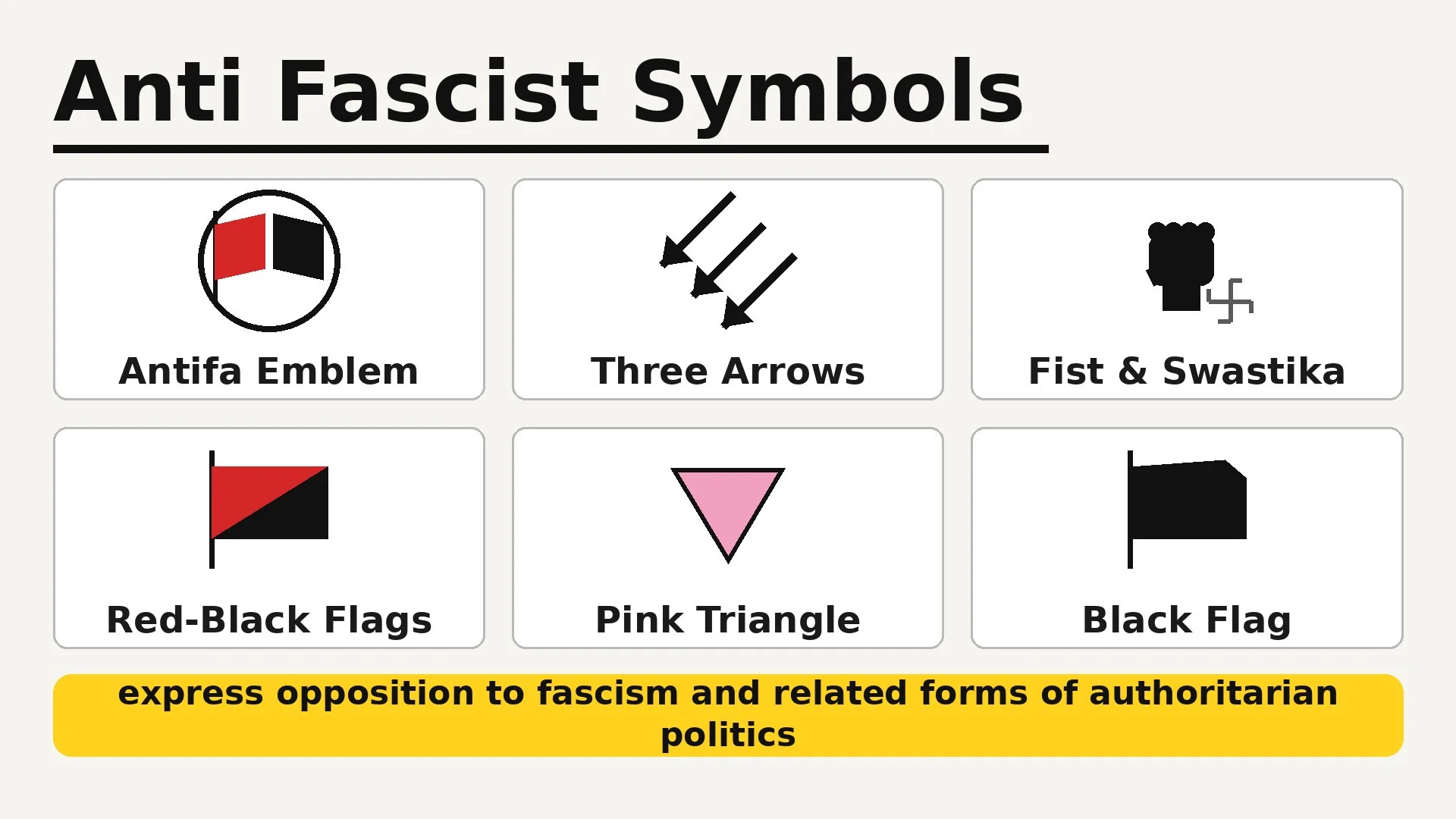
Anti-fascist symbols communicate opposition to fascism, Nazism, authoritarianism, and political movements associated with repression and discrimination. Some are historic emblems created by organized resistance movements, while others developed through anti-racist activism, labor movements, feminist campaigns, and efforts to remember people persecuted under fascist regimes.
The most recognizable examples include the Antifaschistische Aktion emblem, the Three Arrows, and designs showing a fist destroying a swastika. Other imagery, such as red-and-black flags and the pink triangle, has related meanings but comes from different historical traditions.
Understanding these symbols requires more than memorizing their colors or shapes. Their origins, original purposes, modern adaptations, and surrounding context all matter. A symbol may have one documented historical meaning and a broader interpretation today, and displaying a particular design does not automatically establish someone’s political affiliation.
This guide explains the best-known anti-fascist symbols, their meanings, historical development, differences, and practical methods for identifying them accurately.
What Are Anti-Fascist Symbols?
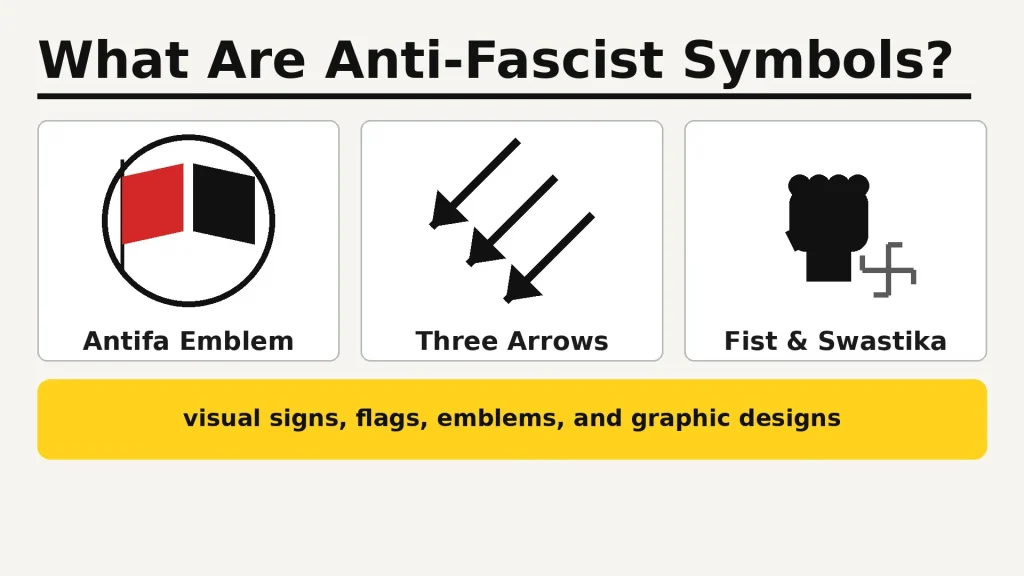
Anti-fascist symbols are visual signs, flags, emblems, and graphic designs used to express opposition to fascism and related forms of authoritarian politics. They may represent resistance to dictatorship, solidarity with persecuted communities, support for democratic rights, or opposition to racist and neo-Nazi movements.
Fascism is generally associated with authoritarian leadership, extreme nationalism, suppression of political opposition, and the use or glorification of political violence. Historical fascist regimes also promoted exclusionary ideas about national identity and persecuted people they considered enemies.
Anti-fascist movements developed in response to these political conditions. However, they have never represented one unified ideology. Socialists, communists, social democrats, anarchists, trade unionists, liberals, and other political groups have opposed fascism for different reasons.
Their symbols reflect this diversity.
Some emblems belong to identifiable historical organizations. Others are associated with broader political traditions or were adopted later by activists seeking to communicate solidarity and resistance.
Why anti-fascist symbols matter
Anti-fascist imagery serves several purposes:
- Political resistance: Communicating opposition to fascist movements, dictatorships, and authoritarian rule.
- Historical remembrance: Keeping the history of resistance and persecution visible.
- Solidarity: Expressing support for people threatened by racism, antisemitism, or other forms of discrimination.
- Collective identity: Connecting people who share particular political or social goals.
- Public communication: Making a political message recognizable on flags, posters, clothing, stickers, and online platforms.
Not every symbol serves all these purposes. Some have narrow historical associations, while others have been adapted for broader contemporary causes.
The Main Anti-Fascist Symbols and Their Meanings
The most useful way to understand anti-fascist symbols is to examine each design separately. The following sections distinguish documented historical origins from interpretations that developed through later use.
The Antifaschistische Aktion Emblem
The Antifaschistische Aktion emblem is among the most recognizable symbols associated with anti-fascism. Its familiar modern form features two waving flags, usually red and black, inside a circular outline.
The original emblem appeared in Germany in 1932 and was associated with Antifaschistische Aktion, a communist-led anti-fascist campaign launched during the final years of the Weimar Republic. Its original design used two red flags, reflecting the political context of the German workers’ movement. The familiar red-and-black version became prominent in later adaptations. Historical artwork and archival records document these distinctions.
The emblem emerged during a period of intense political conflict. The Nazi Party was gaining power, street violence was increasing, and rival political movements were competing for support. Anti-fascist organizing sought to resist Nazism and defend the interests of the workers’ movement.
What the two flags represent
The flags are commonly interpreted through the political traditions associated with them:
- Red flag: Historically associated with socialism, communism, and organized labor.
- Black flag: Associated with anarchism and anarchist political traditions in modern adaptations.
- Circular outline: Frames the two flags as a unified emblem, although it does not have one universally documented independent meaning.
It is important to distinguish the original design from its later form. The original two-red-flag emblem should not be described as though it always contained one red flag and one black flag.
What the Antifa symbol means today
In contemporary use, the emblem often communicates opposition to fascism and solidarity with anti-fascist activism. Some users connect it to anarchist or communist politics, while others use it more broadly as a sign of resistance to far-right movements.
There is no single organization that controls every modern use of the emblem. People who display it may disagree about political strategy, economic policy, and the legitimacy of particular forms of protest.
The design therefore identifies a broad political association, not a complete statement of an individual’s beliefs.
The Three Arrows Symbol
The Three Arrows is a historically important anti-fascist emblem associated with Germany’s Iron Front, a political coalition founded in December 1931. It generally consists of three diagonal arrows, often pointing downward to the left, sometimes enclosed in a circle.
The Iron Front brought together social democratic political forces, trade unions, and allied organizations in opposition to anti-democratic movements, including Nazism. Its symbolism developed in the turbulent final years of the Weimar Republic.
The arrows were designed as a recognizable sign of political resistance. Their bold, simple form made them suitable for posters, banners, and other public-facing political material.
What the Three Arrows mean
The symbol is commonly associated with:
- Opposition to fascism and Nazism.
- Resistance to authoritarian political movements.
- Defense of democratic institutions.
- Solidarity with labor and social democratic movements.
Historical interpretations also connect the three arrows with the Iron Front’s allied political and social forces. Specific explanations of what each arrow represents should be attributed to the relevant historical source rather than treated as universally settled.
How the Three Arrows differ from the Antifa emblem
The Three Arrows and the Antifaschistische Aktion emblem are not the same symbol.
The Antifaschistische Aktion emblem uses two flags within a circular design and is associated with a communist-led campaign. The Three Arrows belong to the history of the Iron Front and the German social democratic movement.
Both are associated with resistance to fascism, but their organizational origins and political backgrounds differ. This distinction is essential for readers studying historical political symbols.
The Fist Breaking a Swastika
A fist striking, smashing, or breaking a swastika is a visual representation of opposition to Nazism. It combines the image of a clenched fist, commonly associated with collective action and resistance, with a symbol strongly associated with the Nazi regime in this context.
The intended message is usually direct: reject Nazi ideology and resist its political legacy.
Unlike the Antifaschistische Aktion emblem or the Three Arrows, a fist breaking a swastika is better understood as a recurring anti-Nazi graphic motif than as one single emblem with a universally agreed historical origin.
Its exact meaning depends on the artwork and accompanying message. It may communicate opposition to neo-Nazism, resistance to antisemitism, rejection of racial supremacy, or remembrance of the victims of Nazi persecution.
The historical distinction between the Nazi swastika and older religious uses of the swastika also matters. A swastika displayed as Nazi propaganda communicates something different from a swastika visibly crossed out or shown being destroyed.
Red-and-Black Flags
Red-and-black flags are associated with anarchist traditions, particularly anarcho-syndicalism and anarchist labor movements. They also appear in some anti-fascist demonstrations.
Red has historically been used by socialist and labor movements, while black has a strong association with anarchism. Combining the colors can communicate cooperation between political traditions that oppose fascism or support collective forms of resistance.
However, a red-and-black flag is not exclusively an anti-fascist symbol. It can represent anarchist politics, labor organizing, or other political traditions without referring to a particular anti-fascist organization.
To identify the intended meaning, examine the accompanying emblem, text, historical setting, and organization using the flag.
The Anti-Nazi League Arrow
Arrow imagery also appeared in British anti-fascist and anti-racist campaigning, including the Anti-Nazi League, which became prominent in the late 1970s.
The Anti-Nazi League organized against neo-Nazism and far-right racism in Britain. Its campaign materials used recognizable graphic imagery to make anti-racist and anti-Nazi messages visible at demonstrations and in public spaces.
This history should be distinguished from the German Three Arrows tradition. Two designs may use arrows without having the same organizational origin.
When researching a specific arrow symbol, look for the original poster, badge, campaign publication, or archival record. An arrow-shaped design alone is not enough to establish a direct connection to the Iron Front or the Anti-Nazi League.
The Pink Triangle
The pink triangle has a different history from the main anti-fascist organizational emblems. Under Nazi rule, authorities used a pink triangular badge to identify men classified as homosexual in the concentration-camp system.
In later decades, LGBTQ+ activists reclaimed the pink triangle as a symbol of remembrance, visibility, solidarity, and resistance to discrimination.
Its history connects Nazi persecution with later campaigns for LGBTQ+ rights. In anti-fascist contexts, it may express solidarity with communities targeted by authoritarian or discriminatory movements.
The pink triangle should not be described as an emblem originally created by an anti-fascist organization. Its significance arises from its use in persecution and its subsequent reclamation.
This distinction is important because a symbol of remembrance can overlap with anti-fascist activism without having originated within an organized anti-fascist movement.
Black Flags and Anarchist Imagery
Black flags are strongly associated with anarchism and appear in some anti-fascist settings. They may be displayed alongside red flags, the Antifaschistische Aktion emblem, or slogans opposing authoritarianism.
However, a black flag by itself does not prove that a person or group is anti-fascist. Black flags have appeared in other political, cultural, and commemorative contexts.
The most accurate interpretation depends on the specific design and the circumstances in which it appears.
Anti-Fascist Symbols and Their Meanings at a Glance
The following comparison helps distinguish the most important symbols without treating every related design as an official anti-fascist emblem.
| Symbol | How to recognize it | Main historical association | Common meaning today |
|---|---|---|---|
| Antifaschistische Aktion emblem | Two waving flags inside a circle | German anti-fascist campaign, 1932 | Opposition to fascism; often left-wing solidarity |
| Three Arrows | Three diagonal arrows, often inside a circle | Germany's Iron Front, founded in 1931 | Resistance to fascism and authoritarianism |
| Fist breaking a swastika | A clenched fist attacking or destroying a swastika | Anti-Nazi protest imagery | Rejection of Nazism |
| Red-and-black flag | Red and black fields or banners | Anarchist and labor traditions | Anarchism, collective action, or anti-fascist solidarity |
| Anti-Nazi League imagery | Campaign-specific arrow designs and slogans | British anti-Nazi campaigning | Opposition to neo-Nazism and racism |
| Pink triangle | A pink triangular shape | Nazi persecution of men accused of homosexuality; later LGBTQ+ reclamation | Remembrance, visibility, and resistance to discrimination |
| Black flag | A plain black flag or anarchist variation | Anarchist political tradition | Anarchism or protest, depending on context |
The historical associations in this table are more specific than the broader meanings sometimes attached to the symbols today. The Antifa emblem’s original design and later color changes are documented in JSTOR’s archival collections; the Iron Front’s Three Arrows are documented by the Anne Frank House; and the pink triangle’s history is explained by the United States Holocaust Memorial Museum.
The History of Anti-Fascist Symbols
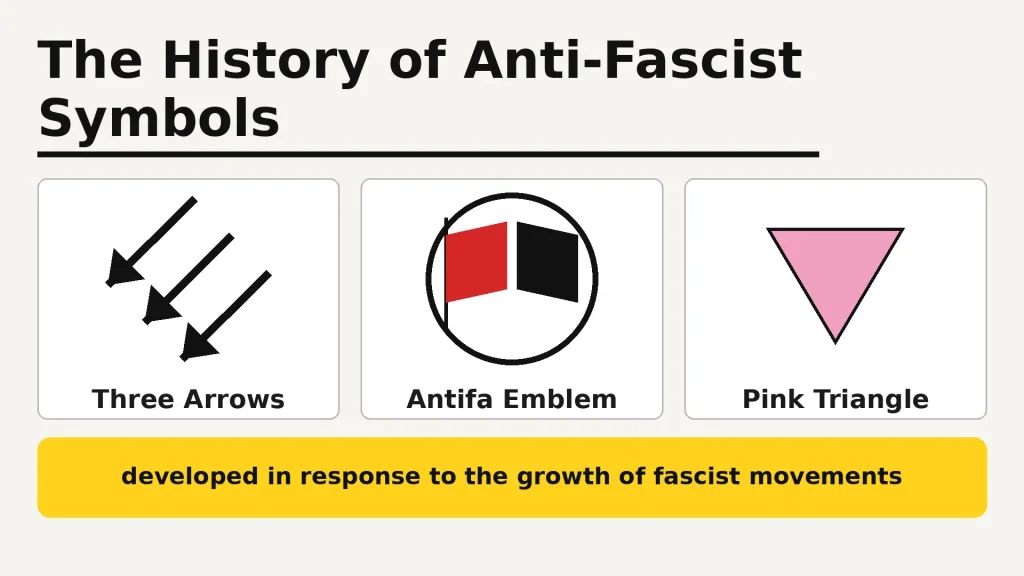
The Rise of Anti-Fascist Imagery in the 1920s and 1930s
Anti-fascist symbolism developed in response to the growth of fascist movements and the political conflicts that followed World War I.
Across Europe, political parties, labor organizations, and social movements competed over the future of government, national identity, economic policy, and civil rights. In Germany, the Weimar Republic faced severe political instability, while Nazi and communist organizations engaged in intense political conflict.
Symbols became a practical way to make political identities visible. Flags, badges, posters, and banners could communicate allegiance or opposition quickly, especially during rallies and street demonstrations.
The Iron Front was founded on December 16, 1931, as a coalition associated with the German Social Democratic Party, trade unions, and other social democratic organizations. Its Three Arrows became a recognizable emblem of resistance to anti-democratic movements.
Antifaschistische Aktion emerged in 1932 in a different political context. Its original emblem used two red flags, and its campaign was associated with the Communist Party of Germany. The two movements opposed Nazism but differed in their political affiliations and strategies.
These origins explain why the two symbols should not be treated as interchangeable, even though both are widely recognized as anti-fascist imagery today.
Anti-Fascist Resistance Under Nazi Rule
After Adolf Hitler became chancellor in January 1933, the Nazi regime dismantled democratic institutions and suppressed political opposition. Independent trade unions were destroyed, rival political organizations were banned or persecuted, and opponents of the regime faced imprisonment and other forms of repression.
Resistance took many forms. People distributed illegal publications, maintained underground political networks, assisted persecuted individuals, and challenged Nazi authority in different ways. Some participated in organized resistance groups, while others acted independently or within religious, labor, and community networks.
There was no single symbol shared by every person who resisted Nazism. Some symbols belonged to particular political movements, while other forms of resistance were expressed through words, clandestine publications, or actions rather than a distinctive emblem.
This distinction matters because modern anti-fascist imagery often brings together different histories of resistance. A symbol used today may honor the broader principle of resisting authoritarianism without representing the exact organization or methods of a historical resistance group.
Anti-Fascist Symbols After World War II
After the defeat of Nazi Germany in 1945, anti-fascist imagery continued to appear in political organizing, labor movements, anti-racist activism, and campaigns against the far right.
The original Antifaschistische Aktion emblem did not disappear from political culture. Later activists adapted it, and the now-familiar combination of red and black flags became prominent in subsequent decades.
The Three Arrows also retained historical significance as an emblem associated with democratic and social democratic resistance. Its appearance in later campaigns demonstrates how an older political symbol can be reused in a new context.
Meanwhile, other imagery developed its own path. The pink triangle, originally associated with persecution under Nazi rule, was reclaimed by LGBTQ+ activists in later decades. Its modern significance is connected to remembrance and the struggle against discrimination rather than to the founding of a particular anti-fascist organization.
Anti-Fascist Symbols in the Modern Era
Modern anti-fascist imagery appears in protest movements, political publications, online communities, educational materials, and cultural settings.
The Antifa emblem is used by different groups and individuals who oppose fascism, though their ideologies and preferred tactics may differ. The Three Arrows continue to be used in some democratic socialist and anti-fascist contexts. Related imagery may communicate opposition to neo-Nazism, racism, antisemitism, or discrimination against minority groups.
Contemporary adaptations also combine older designs with new colors, slogans, and graphic elements. For example, archival material documents black-and-purple versions of the Antifaschistische Aktion emblem associated with feminist and anarchist ideas.
These adaptations illustrate how political symbolism changes. An emblem can preserve its connection to an older movement while acquiring additional meanings for people using it today.
What Do the Colors in Anti-Fascist Symbols Mean?
Colors can help identify a political symbol, but they should not be interpreted in isolation. Their significance depends on the design, the movement using them, and the historical period.
Red: Socialism and Labor Movements
Red has a long history in socialist, communist, and labor movements. It can represent working-class solidarity, collective action, and opposition to political or economic oppression.
In the original Antifaschistische Aktion emblem, the two red flags represented the German Social Democratic Party and Communist Party of Germany in the historical account documented by JSTOR’s archive. Later red-and-black versions connected red with socialist and communist traditions and black with anarchism.
The original historical meaning is more precise than the general claim that red always means resistance to fascism.
Black: Anarchism and Anti-Authoritarian Politics
Black is strongly associated with anarchist political traditions. It appears in anarchist flags and in some anti-fascist designs, including later versions of the two-flag emblem.
Depending on the context, it may express anarchist identity, opposition to authoritarian power, or solidarity with a particular movement.
However, black also appears in mourning, national flags, artistic expression, and unrelated political traditions. A black flag alone does not establish anti-fascist affiliation.
Purple: Feminism and Related Activism
Purple appears in some political designs associated with feminism and women’s movements. When combined with black in an adapted Antifaschistische Aktion emblem, it can communicate a relationship between feminist and anarchist political ideas.
This is a specific example of modern adaptation, not evidence that purple has a universal meaning in anti-fascist symbolism.
Pink: Historical Persecution and LGBTQ+ Remembrance
Pink is particularly significant in the history of the pink triangle. The Nazi regime used this badge to identify men classified as homosexual in concentration camps. Later LGBTQ+ activists reclaimed the triangle as a symbol of visibility and remembrance.
Holocaust Encyclopedia
+1
In contemporary activism, the pink triangle may communicate solidarity with LGBTQ+ communities and opposition to discrimination. Its historical significance is distinct from the original Antifaschistische Aktion and Iron Front emblems.
Anti-Fascist Symbols vs. Fascist and Nazi Symbols
Anti-fascist symbols are frequently designed to oppose fascist ideology, but the difference between a symbol of opposition and a symbol of allegiance depends on how it is used.
| Feature | Anti-fascist imagery | Fascist or Nazi imagery |
|---|---|---|
| Typical purpose | Communicate opposition to fascism | Represent or promote fascist ideology |
| Examples | Antifa emblem, Three Arrows, crossed-out swastika | Nazi swastika flag and Nazi insignia |
| Common contexts | Protest, education, resistance, remembrance | Historical records, propaganda, extremist displays, museums |
| Key interpretive question | Is the design rejecting or documenting fascism? | Is the design promoting, documenting, or criticizing the ideology? |
Why the swastika requires historical context
The swastika existed long before the Nazi Party adopted it and remains a religious symbol in several traditions, including Hinduism and Buddhism. Its meaning therefore depends heavily on the cultural setting and the specific form in which it appears.
In Nazi Germany, the swastika became a central emblem of the regime responsible for antisemitic persecution, racial oppression, aggressive war, and the Holocaust.
A swastika displayed as Nazi propaganda is not equivalent to a swastika crossed out in an anti-Nazi poster. The surrounding message and historical context are essential to interpretation.
How to distinguish opposition from endorsement
When a symbol includes a swastika or other extremist imagery, ask:
- Is the symbol crossed out, broken, or visibly rejected?
- Does the accompanying text condemn or praise the ideology?
- Is the material part of a historical exhibit, news report, or educational resource?
- Does the source explain the image’s purpose?
- Is there reliable evidence of how the person or organization intends the symbol to be understood?
These questions help avoid mistaking criticism of extremist ideology for its endorsement.
How to Identify Anti-Fascist Symbols Correctly
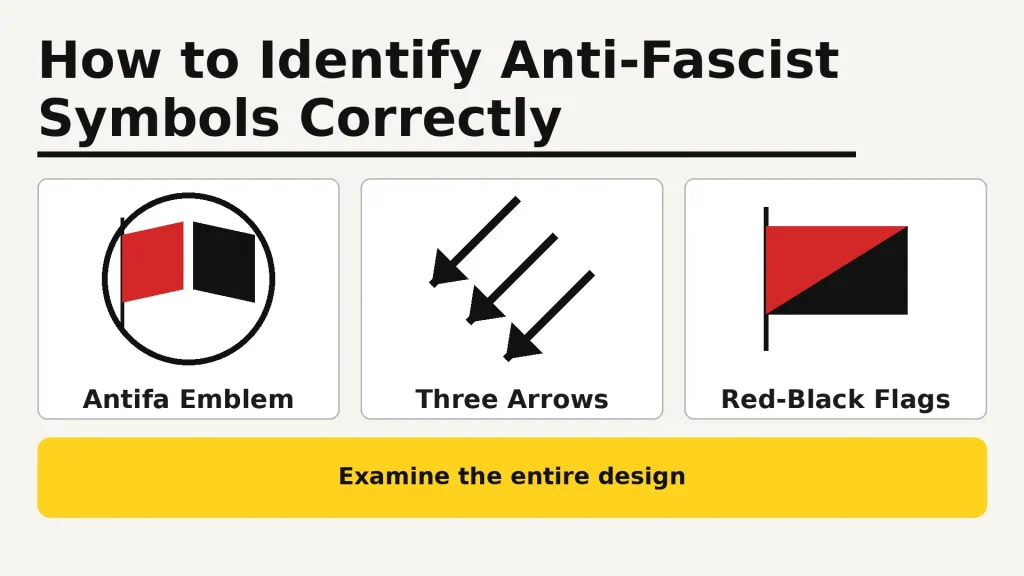
Recognizing anti-fascist symbols is easier when you examine the entire design instead of relying on a single color or shape.
Look at the shape and arrangement
The Antifaschistische Aktion emblem typically features two waving flags within a circle. The Three Arrows features three separate diagonal arrows, often enclosed in a circular outline.
These structural differences help distinguish the designs even when they use similar colors or appear on the same protest banner.
Check the historical origin
A symbol’s origin can reveal whether it belongs to a particular organization or represents a broader political tradition.
For example, the Antifaschistische Aktion emblem is associated with a German campaign launched in 1932, while the Three Arrows are connected to the Iron Front, founded in 1931.
When an unfamiliar symbol resembles one of these designs, look for historical records or an identifiable organizational source before assigning it a name.
Examine accompanying text and slogans
Words surrounding a symbol can clarify its purpose. An emblem displayed beside a slogan opposing Nazism communicates something different from a similar-looking graphic used in a general historical discussion.
Campaign names, dates, organization logos, and accompanying statements can help establish the context.
Distinguish historical symbols from modern adaptations
Contemporary activists sometimes modify older designs by changing colors, adding lettering, or combining different political symbols.
These adaptations may preserve the original emblem’s central message while introducing additional associations. Do not assume that every modified version has the same history or represents the same organization.
Avoid judging individuals by symbols alone
A symbol can provide evidence of a political association, but it is not conclusive proof of an individual’s beliefs, organizational membership, or conduct.
People may display an emblem for historical study, artistic expression, political solidarity, or other reasons. A reliable interpretation considers the design, the source, the context, and any relevant statements or actions.
Common Misconceptions About Anti-Fascist Symbols
Every anti-fascist symbol represents communism
This is incorrect. The original Antifaschistische Aktion emblem emerged from a communist-led campaign, but anti-fascist politics includes a range of ideological traditions. The Three Arrows, for example, are associated with the social democratic Iron Front.
Other symbols are connected to anarchism, anti-racism, LGBTQ+ remembrance, or broader resistance movements.
The Antifa emblem has always used red and black flags
The original emblem used two red flags. The familiar red-and-black version developed through later adaptations, particularly from the 1980s onward.
This is an important historical detail because the modern design should not be confused with the original artwork.
The Three Arrows and Antifa emblem mean exactly the same thing
Both are associated with anti-fascist resistance, but they emerged from different organizations and political traditions. Their shared opposition to fascism does not make their histories identical.
Every black flag represents anti-fascism
Black flags have strong associations with anarchism, but they are also used in other political and cultural contexts. The flag’s design and surrounding circumstances determine its more specific meaning.
The pink triangle was originally an anti-fascist logo
The pink triangle originated as a badge imposed on men classified as homosexual by the Nazi concentration-camp system. Its later use as a symbol of LGBTQ+ remembrance and resistance was a reclamation of that history.
A symbol proves that someone supports violence
A symbol alone cannot establish a person’s behavior or preferred political tactics. Some people use anti-fascist imagery in peaceful demonstrations, historical education, or campaigns against discrimination. Any conclusion about an individual’s conduct requires additional evidence.
Frequently Asked Questions About Anti-Fascist Symbols
What is the main anti-fascist symbol?
The Antifaschistische Aktion emblem, commonly known as the Antifa symbol, is one of the best-known anti-fascist symbols. It typically shows two waving flags inside a circle. The Three Arrows, associated with Germany’s Iron Front, are another important historical emblem.
What does the Antifa symbol mean?
The Antifa symbol communicates opposition to fascism and is often associated with left-wing political activism. Its familiar modern design features a red flag and a black flag inside a circle. The original 1932 emblem used two red flags, so the two versions have a historical distinction.
What do the Three Arrows represent?
The Three Arrows are associated with resistance to fascism and anti-democratic political movements. The emblem belonged to Germany’s Iron Front, a coalition founded in December 1931 that included social democratic organizations and trade unions.
What is the difference between the Antifa symbol and the Three Arrows?
The Antifa emblem features two flags within a circle and originated with Antifaschistische Aktion in 1932. The Three Arrows consist of three diagonal arrows and are associated with the Iron Front, founded in 1931. Both oppose fascism, but their origins and political affiliations differ.
What do the red and black flags mean in the Antifa emblem?
In the modern emblem, red is associated with socialism and communism, while black is associated with anarchism. Together, they commonly represent different left-wing political traditions united in opposition to fascism. The original design used two red flags.
Is the pink triangle an anti-fascist symbol?
The pink triangle has become a symbol of LGBTQ+ remembrance and resistance to discrimination. Its origins lie in the Nazi persecution of men classified as homosexual, who were forced to wear pink triangular badges in concentration camps. LGBTQ+ activists later reclaimed the design.
What does a fist breaking a swastika mean?
It usually expresses opposition to Nazism. The fist communicates resistance, while the broken or crossed-out swastika indicates rejection of Nazi ideology. The precise interpretation depends on the accompanying text and design.
Are anti-fascist symbols always political?
These symbols are generally political in their historical or contemporary associations, but they may also appear in academic research, museum displays, documentaries, and educational settings. Their appearance does not automatically mean that the person displaying or discussing them belongs to a political organization.
Can the same symbol have different meanings in different countries?
Yes. Political history, local movements, and cultural traditions influence how a symbol is understood. An emblem may refer to a specific historical organization in one setting and serve as a broader symbol of resistance in another.
How can I verify the origin of an unfamiliar anti-fascist symbol?
Start by documenting its shape, colors, text, and any identifiable organization name. Then consult museum collections, historical archives, academic research, or original campaign materials. Be cautious with unsourced social media posts and websites that assign a definite meaning to a symbol without providing evidence.
Why Anti-Fascist Symbols Remain Relevant Today
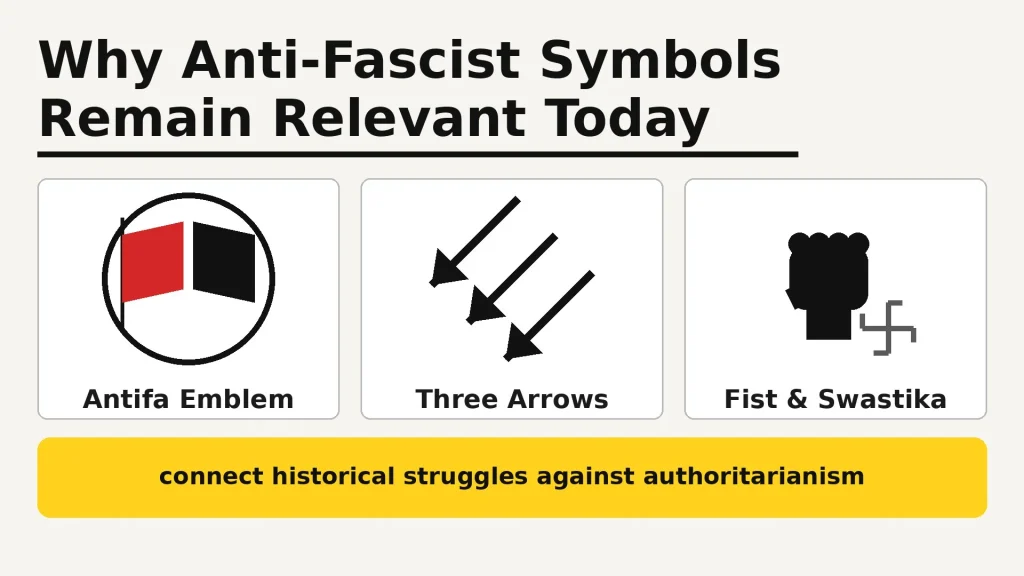
Anti-fascist symbols remain relevant because they connect historical struggles against authoritarianism with contemporary debates about democracy, political freedom, racism, and discrimination.
For some people, the Antifa emblem communicates solidarity with modern anti-fascist activism. For others, the Three Arrows represents a historical tradition of defending democratic institutions. Related imagery can also preserve the memory of people persecuted under Nazi rule or communicate opposition to neo-Nazi movements.
Their continued use illustrates how political symbols can survive beyond their original organizations. At the same time, their meanings may change as new generations adapt them to contemporary issues.
Understanding this history requires careful distinctions. Not every symbol has the same origin, not every modern interpretation reflects the original purpose, and not everyone using a particular design shares identical political beliefs.
Final Thoughts on Anti-Fascist Symbols
Anti-fascist symbols are visual expressions of resistance, solidarity, political identity, and historical remembrance. The Antifaschistische Aktion emblem and Three Arrows are two of the most recognizable examples, but they come from distinct organizations and political traditions.
Red-and-black flags, anti-Nazi protest graphics, and the pink triangle have related associations without sharing one common origin. Their meanings become clearer when their histories, visual details, and modern uses are examined separately.
The most reliable way to identify an anti-fascist symbol is to consider its design, historical background, and surrounding context together. This approach helps readers distinguish established historical facts from later interpretations and understand the messages that different symbols are intended to communicate.
Related Articles
- Satanic Symbols: Meanings, History, and How to Identify Them Correctly
- Pagan Symbols and Meanings: Ancient Origins, Modern Traditions, and How to Identify Them
- Masonic Symbols: Complete Meanings, Origins, and How to Identify Them

I’m Amelia Richardson, a language writer who enjoys discovering the meaning behind words, phrases, and expressions. I believe good language content should be simple, accurate, and useful in real situations. At Meanera, I write easy-to-follow explanations that help readers understand everything from common vocabulary to modern slang.
Books:
- A Journey Through English Words
- Expressions Made Easy
 Grace Harrison
 Lucas Thompson