Guitar tab symbols make it easier to learn songs, riffs, chords, and solos without having to read traditional sheet music. If you have ever opened a guitar tab and wondered what h, p, /, \, b, x, or ~ means, understanding these markings will help you play with greater confidence.
Guitar tablature, commonly called guitar tabs, uses six horizontal lines to represent the strings of a standard six-string guitar. Numbers indicate which frets to play, while letters and special symbols explain techniques such as hammer-ons, pull-offs, slides, string bends, vibrato, and palm muting.
However, guitar tabs are not always written in exactly the same way. Some symbols have widely accepted meanings, while others depend on the website, book, or software used to create the tab. Learning how to interpret the notation in context is just as important as memorizing the symbols.
This complete guide explains the most common guitar tab symbols, provides a quick-reference chart, demonstrates how to play each technique, and covers rhythm, chords, advanced markings, common mistakes, and practical exercises. By the end, you will have a clear foundation for reading guitar tabs on acoustic and electric guitar.
What Are Guitar Tab Symbols?
Guitar tab symbols are numbers, letters, and special markings used in tablature to show how music can be played on a guitar. They indicate which string to use, which fret to press, how notes relate to one another, and which playing techniques create the intended sound.
Traditional sheet music represents pitch and rhythm using a musical staff. Guitar tablature takes a more instrument-specific approach by showing string and fret positions directly.
For example, consider this short tab:
e|—————-|
B|—————-|
G|—————-|
D|——2———|
A|–0——-3—–|
E|—————-|
Here is how to read it:
- The top line represents the high E string.
- The bottom line represents the low E string.
- 0 means play a string without pressing any fret.
- 2 means press the second fret of the indicated string.
- 3 means press the third fret of the indicated string.
- The notes are read from left to right.
In this example, play the open A string, then the second fret of the D string, followed by the third fret of the A string.
The vertical alignment of numbers matters. Numbers lined up vertically usually indicate notes played together, while numbers appearing at different horizontal positions generally indicate notes played in sequence.
Guitar tabs are particularly useful for learning riffs, melodies, solos, and chord shapes. However, basic text tabs may not show complete rhythm information, so you may need a recording, a tempo marking, or standard notation to reproduce the music accurately.
Guitar Tab Symbols Chart: Quick Reference Guide
The following chart covers common guitar tab symbols and their usual meanings. Keep in mind that notation conventions can vary, especially for harmonics, tapping, vibrato, and special effects.
| Symbol | Name | Meaning |
| 0 | Open string | Play without pressing a fret |
| 1, 2, 3 | Fret numbers | Press the indicated fret |
| h | Hammer-on | Sound a higher fretted note without picking again |
| p | Pull-off | Sound a lower fretted note by releasing a finger |
| / | Slide up | Slide toward a higher fret |
| \ | Slide down | Slide toward a lower fret |
| b | Bend | Raise the pitch by bending the string |
| r | Bend release | Return a bent note toward its original pitch |
| ~ | Vibrato | Add controlled pitch variation |
| x | Muted or dead note | Produce a percussive, muted sound |
| PM or P.M. | Palm mute | Dampen the strings with the picking-hand palm |
| t or T | Tapping | Tap a fret to sound a note |
| <12> | Often a natural harmonic | Lightly touch the string at the indicated fret position |
| AH | Artificial harmonic | Produce a harmonic using a specialized technique |
| PH | Pinch harmonic | Produce a high, sharp harmonic, commonly on electric guitar |
| tr | Trill | Rapidly alternate between two notes |
| (5) | Context-dependent notation | May indicate a ghost, optional, grace, or sustained note |
| let ring | Sustain instruction | Allow notes to continue sounding |
| mute | Muting instruction | Stop notes from ringing |
| v and ^ | Often picking directions | Usually downstroke and upstroke, respectively, in some notation systems |
Some tabs also include bend arrows, rhythm stems, note-duration markings, tremolo-bar instructions, and other specialized notation.
Important: This is a general reference, not a universal symbol dictionary. Always read the tab’s legend when one is provided. A symbol can mean something different depending on whether it appears in a guitar tab, a chord diagram, or another notation format.
How to Read Guitar Tabs Step by Step
Before learning individual techniques, understand the basic structure of tablature. This will help you interpret almost any beginner-level guitar tab.
Understand the Six Guitar Tab Lines
A standard six-string guitar tab contains six horizontal lines, with each line representing one string.
e|—————-| High E string
B|—————-| B string
G|—————-| G string
D|—————-| D string
A|—————-| A string
E|—————-| Low E string
In standard tuning, the strings are tuned from lowest to highest pitch as E, A, D, G, B, and E. Tabs normally display them from highest to lowest, placing the high E string at the top.
This layout can initially feel backward because the top line represents the thinnest string rather than the thickest one.
A useful memory trick is to read the tab from top to bottom as high E, B, G, D, A, and low E. The letter labels, when present, identify the strings directly.
Some tabs omit the letter labels after the opening passage. Once you understand the line order, you can still read them correctly.
Learn What Fret Numbers Mean
Numbers on the tab tell you which fret to press on the corresponding string.
e|–0–1–3–5–|
This sequence means:
- 0: play the open high E string.
- 1: press the first fret of the high E string.
- 3: press the third fret.
- 5: press the fifth fret.
Fret numbers are not finger numbers. The number 5 does not mean that you must use your fifth finger. It means the note is played at the fifth fret, and you choose an appropriate fingering.
Press the string just behind the metal fret wire rather than directly on top of it. This usually produces a clearer note with less buzzing.
Understand Dashes and Spacing
Dashes connect the numbers and represent the spaces between notes.
e|–0—2—3—5–|
Read this from left to right, playing each indicated fret in order.
The horizontal spacing can help you visualize the sequence, but the number of dashes is not a reliable measurement of note duration. In plain-text tabs, spaces are often used for readability rather than exact musical timing.
If you need to know whether a note lasts one beat or half a beat, look for rhythm notation or listen to the recording.
Recognize Vertical Alignment
Numbers that appear directly above one another generally indicate notes played simultaneously.
e|–0–|
B|–0–|
G|–0–|
D|–2–|
A|–2–|
E|–0–|
This is an open-position E minor chord voicing. Strum the indicated strings together.
When the numbers appear at different horizontal positions, you generally play them one after another. This distinction is essential when reading arpeggios, chord progressions, and single-note riffs.
Understand Bar Lines and Measures
Vertical lines sometimes divide a tab into measures, also called bars.
e|–0—2—|–3—5—|
B|———-|———-|
G|———-|———-|
D|———-|———-|
A|———-|———-|
E|———-|———-|
The vertical line separates two measures. A measure contains a specific number of beats according to the time signature.
Bar lines help you organize a song, identify repeated sections, and keep track of where you are while practicing. However, informal tabs may omit them.
Hammer-On Symbol (h) in Guitar Tabs
The letter h stands for hammer-on. This technique allows you to sound a higher note by pressing a fret with your fretting hand without picking the string again.
Example:
G|—-5h7—-|
To play this passage:
- Place one finger on the fifth fret of the G string.
- Pick the string to sound the fifth-fret note.
- While the string is vibrating, press the seventh fret firmly with another finger.
- Let the seventh-fret note ring without picking it a second time.
The second note should sound clear and strong. If it is too quiet, practice pressing the fret more decisively while keeping your hand relaxed.
When to Use a Hammer-On
Hammer-ons are useful when moving from a lower note to a higher note on the same string. They create a smooth connection between notes and are commonly used in rock riffs, blues licks, acoustic melodies, and guitar solos.
For example, 3h5 means play the third fret and hammer onto the fifth fret. The first note is picked, and the second note is produced by the hammer-on.
A hammer-on is a type of legato technique, which means notes are connected smoothly rather than being picked individually. It can help you play faster passages while reducing the number of pick strokes.
Common Hammer-On Mistakes
Beginners often lift the first finger too early or press the next fret too lightly. Both problems can make the second note sound weak.
Keep your first finger in position until the second note sounds clearly. Then practice the movement slowly, gradually increasing speed without sacrificing clarity.
Pull-Off Symbol (p) in Guitar Tabs
The letter p stands for pull-off. It allows you to sound a lower note by releasing a finger from a higher fret while another finger remains positioned on the lower fret.
Example:
G|—-7p5—-|
To play this passage:
- Place one finger on the fifth fret of the G string.
- Place another finger on the seventh fret.
- Pick the seventh-fret note.
- Release the seventh-fret finger with a small, controlled sideways movement so the fifth-fret note sounds.
A pull-off is not simply lifting your finger straight off the string. A slight pulling motion helps the lower note vibrate clearly.
Hammer-On vs. Pull-Off
| Feature | Hammer-on | Pull-off |
| Symbol | h | p |
| Example | 5h7 | 7p5 |
| Note movement | Lower to higher fret | Higher to lower fret |
| Second pick stroke | Usually unnecessary | Usually unnecessary |
| Main technique | Press a higher fret | Release a higher fret while sounding the lower note |
These techniques often appear together in guitar tabs, such as 5h7p5. This means pick the fifth fret, hammer onto the seventh fret, and pull off back to the fifth fret.
Practice this pattern slowly until all three notes sound distinct. It is particularly useful for developing finger strength, coordination, and smooth lead guitar playing.
Slide Symbols (/ and ) in Guitar Tabs
A slide involves moving your fretting finger along the same string from one fret position to another while the note continues to sound.
The two common text-tab symbols are / and \.
Slide Up Symbol (/)
A forward slash commonly indicates a slide toward a higher fret.
G|—-5/7—-|
Play the fifth fret, then slide your finger to the seventh fret while maintaining enough pressure to keep the string vibrating.
In many tabs, you do not pick the destination note again. However, some arrangements may specify a separately picked note, so pay attention to the context.
Slides create a smooth rising sound and are frequently used in blues, rock, country, and lead guitar melodies.
Slide Down Symbol ()
A backslash commonly indicates a slide toward a lower fret.
G|—-7\5—-|
Play the seventh fret and slide down to the fifth fret without completely lifting your finger from the string.
Try to maintain a consistent sound throughout the movement. If you lift your finger too early, the slide may stop before reaching the destination note.
What Do /7 and \5 Mean?
You may encounter a slide marking with only one written fret number, such as /7 or \5.
This often indicates sliding into a target note from an unspecified or approximate starting position. The exact starting fret may not be important, or it may be shown in another part of the notation.
Check the tab’s legend and listen to the original recording if the starting position is unclear.
Bend Symbol (b) in Guitar Tabs
The letter b stands for string bending. You bend a string sideways with your fretting hand to raise the pitch of the note.
Example:
B|—-8b10—-|
This usually means play the eighth fret on the B string and bend the note until it reaches the pitch associated with the tenth fret.
The number after b identifies the intended target pitch in this notation style. Some tabs use arrows or other markings to show the bend direction and amount.
Half-Step and Whole-Step Bends
A half-step bend raises a note by one semitone, while a whole-step bend raises it by two semitones.
For example, a bend from the eighth fret toward the pitch of the ninth fret represents a half-step bend. A bend from the eighth fret toward the pitch of the tenth fret represents a whole-step bend.
The physical distance you move the string depends on the string, guitar setup, and playing position. Focus on matching the target pitch rather than trying to move the string a fixed distance.
Pre-Bends
A pre-bend means you bend the string before picking the note. You then sound the note while the string is already bent to the intended pitch.
Some tabs mark pre-bends with a PB abbreviation or a bend arrow. Notation varies, so check the accompanying instructions.
Pre-bends are often used in blues and rock solos to create an expressive note that starts at an elevated pitch.
Bend and Release
The letter r commonly indicates a bend release.
B|—-8b10r8—-|
Play the eighth fret, bend to the pitch of the tenth fret, and then release the bend until the original eighth-fret pitch returns.
Keep the release controlled. The note should return smoothly rather than snapping back abruptly.
How to Improve Your Bending Accuracy
Use your fingers together when necessary to support the bending finger, and keep your wrist in a comfortable position. Listen to the target note before bending so you know what pitch you are trying to reach.
If the note sounds too low, the bend has not reached its target. If it sounds too high, you have bent too far. Practicing slowly with a tuner can help you develop consistent pitch control.
Vibrato Symbol (~) in Guitar Tabs
The tilde ~ often represents vibrato, a technique that adds subtle, repeated pitch variation to a sustained note.
Example:
e|—-7~~~~—-|
Hold the seventh-fret note and make small, controlled movements with your fretting hand to vary the pitch. The result should sound expressive and deliberate rather than like an uncontrolled shake.
Vibrato is common in blues, rock, classical guitar, and melodic solos. Its speed and width can change the character of a note.
A slow, narrow vibrato may sound gentle, while a wider or faster vibrato can create a more intense effect. The appropriate style depends on the music.
The tilde is not the only way vibrato is represented. Some tabs use a wavy line above a note or provide a written instruction.
Remember: The mark ~ can be used differently in some notation systems. Check the tab’s legend when the meaning is unclear.
Muted Note Symbol (x) in Guitar Tabs
The symbol x commonly indicates a muted note, also called a dead note. Instead of producing a clearly pitched note, the string creates a short, percussive sound.
Example:
E|—-0—x—3—x—-|
Here, the open low E note is followed by a muted hit, then a third-fret note and another muted hit.
To produce a dead note, lightly touch the string with your fretting hand without pressing it firmly enough to create a normal pitch. Strike the string with your picking hand to produce the muted sound.
Muted notes help create rhythmic accents in funk, rock, pop, and percussive acoustic strumming.
Muted Notes vs. Unplayed Strings
The meaning of x depends on where it appears.
| Where the symbol appears | Usual meaning |
| On a guitar tab line | Strike the string while muting it, creating a percussive sound |
| Above a string in a chord diagram | Do not play that string |
| In a custom notation system | Follow the legend or written instructions |
This distinction is important because playing a muted string and not playing a string at all produce different results.
Palm Mute Symbol (PM) in Guitar Tabs
PM or P.M. means palm muting. You rest the edge of your picking-hand palm lightly against the strings near the bridge while playing.
Palm muting reduces sustain and creates a tighter, more controlled sound. It is especially common in rock, punk, hard rock, and metal.
Example:
PM———
E|–0–0–0–0–|
The marking indicates that the notes within the marked passage should be palm-muted.
How to Palm Mute Correctly
Position the edge of your picking-hand palm close to the bridge, where the strings pass over the bridge saddles. Apply enough pressure to dampen the strings slightly without completely silencing them.
If you mute too heavily, the notes may become difficult to hear. If you barely touch the strings, they may ring too freely.
Palm muting is different from fretting-hand muting. Palm muting uses the picking hand to reduce string vibration, while fretting-hand muting uses the other hand to stop or dampen notes.
When a tab marks only part of a riff for palm muting, pay attention to where the marking begins and ends. Alternating between muted and open notes often creates the groove of a guitar riff.
Tapping Symbol (t or T) in Guitar Tabs
The letter t or T can indicate tapping, a technique in which a finger, often from the picking hand, taps a fret to sound a note.
Example:
e|—-5h8t12p8p5—-|
This illustrative pattern combines several techniques:
- Pick the fifth fret.
- Hammer onto the eighth fret.
- Tap the twelfth fret with a finger from the picking hand.
- Pull off to the eighth fret.
- Pull off again to the fifth fret.
Tapping lets guitarists play wide intervals and fast passages that can be difficult to perform using conventional picking alone.
Some tab writers mark tapped notes with a T above the tab rather than placing t directly beside the fret number. The notation is not completely standardized.
Beginners should start slowly, ensuring that every tapped note sounds clearly and that the pull-offs do not create unwanted string noise.
Harmonic Symbols in Guitar Tabs
Harmonics produce clear, bell-like tones that sound different from ordinary fretted notes. Guitar tabs can identify several types of harmonics, including natural harmonics, artificial harmonics, and pinch harmonics.
Natural Harmonics
Natural harmonics are often written as <12>, <7>, or <5>, depending on the intended harmonic position and the notation system.
Example:
e|—-<12>—-|
To play a natural harmonic at the twelfth fret, lightly touch the string directly above the twelfth-fret wire. Pick the string and immediately lift your touching finger.
Do not press the string down against the fretboard. The goal is to allow the harmonic to ring clearly.
Natural harmonics are commonly played at the twelfth fret and can also be produced at other suitable positions, including the fifth and seventh frets.
Artificial Harmonics
AH may stand for artificial harmonic. This technique produces a harmonic on a string that is already fretted, using a specific picking-hand or fretting-hand technique.
Artificial harmonics require more coordination than basic natural harmonics. Because the notation and execution can vary, follow the tab’s instructions rather than assuming every AH marking describes the same technique.
Pinch Harmonics
PH commonly stands for pinch harmonic, a technique often used on electric guitar to produce a sharp, high-pitched sound.
A typical pinch harmonic involves striking the string with a pick and allowing the thumb to contact the string immediately afterward. The picking position and technique affect which harmonic sounds.
Pinch harmonics are frequently used in rock and metal solos. They can take time to master, so practice them slowly and consistently before attempting them in fast passages.
Other Guitar Tab Symbols and Notation You May Encounter
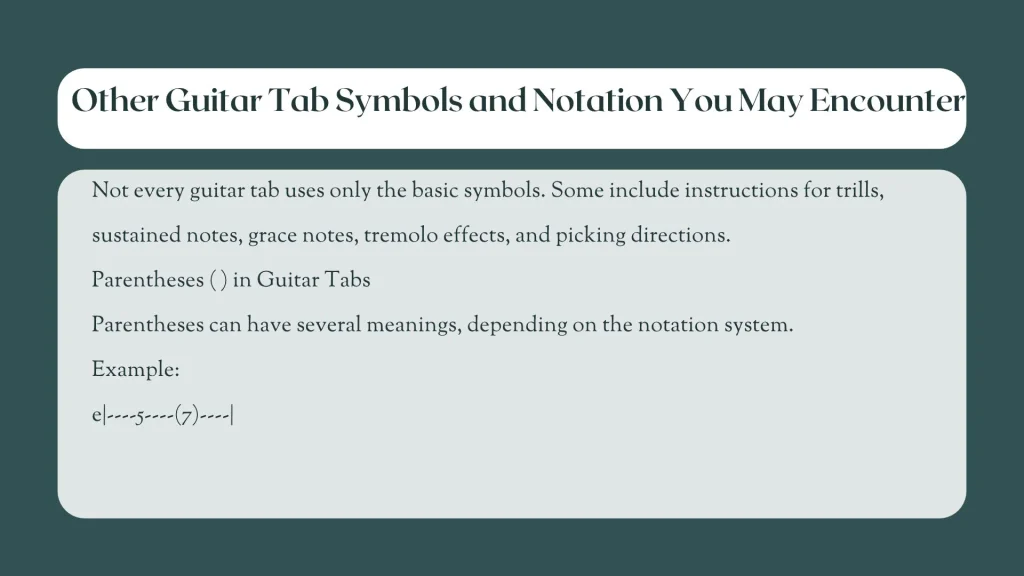
Not every guitar tab uses only the basic symbols. Some include instructions for trills, sustained notes, grace notes, tremolo effects, and picking directions.
Parentheses ( ) in Guitar Tabs
Parentheses can have several meanings, depending on the notation system.
Example:
e|—-5—-(7)—-|
A parenthesized note may indicate a ghost note, an optional note, a grace note, or a note that continues ringing from an earlier strike. In some tab formats, it may identify a quieter or less strongly articulated note.
Because these interpretations are not interchangeable, do not assume that every number inside parentheses should be played the same way.
Check the tab’s legend or listen to the recording to understand what the writer intended.
Trill Symbol (tr)
The abbreviation tr commonly indicates a trill, a rapid alternation between a main note and a nearby note.
A trill can be performed using repeated hammer-ons and pull-offs.
For example, a trill instruction over the fifth fret might tell you to alternate rapidly between the fifth and sixth frets. The exact speed and duration depend on the musical passage.
Trills are useful in melodic passages and solos where a quick, ornamented sound is desired.
Let Ring
The instruction let ring means allow a note or group of notes to continue sounding instead of stopping them immediately.
This is especially important in acoustic guitar melodies, arpeggios, open chords, and clean electric guitar passages.
Example:
e|—-0———|
B|——–1—–|
G|————0-|
If the tab instructs you to let the notes ring, allow the earlier notes to continue vibrating as you play the later ones, where the fingering permits.
This may require careful finger movement to avoid accidentally touching and muting strings that should continue sounding.
Muting Instructions
Words such as mute, PM, and other written instructions may tell you when to stop notes from ringing.
Muting helps control sustain, reduce unwanted noise, and make rhythmic patterns sound cleaner.
If a riff sounds muddy, check whether some notes should be muted rather than allowed to sustain. You may need to use your picking hand, fretting hand, or both.
Picking Direction Symbols (v and ^)
Some tablature systems use v and ^ to represent picking directions.
In many such systems:
- v means a downstroke.
- ^ means an upstroke.
A downstroke moves the pick toward the floor, while an upstroke moves it toward the ceiling. These terms describe the direction of the picking movement, not whether the note is higher or lower in pitch.
The symbols may be placed above notes or within a rhythmic notation line. Because their use varies, check the legend when provided.
Picking directions are particularly useful for strumming patterns, alternate picking, and passages that require consistent rhythm.
Tremolo Picking
Tremolo picking involves rapidly repeating a note with alternating or repeated pick strokes.
Some tabs use a tremolo marking or written instruction to indicate this technique. The exact notation depends on the source.
Do not confuse tremolo picking with vibrato. Tremolo picking repeats the note rapidly, while vibrato changes the pitch of a sustained note.
Whammy Bar and Tremolo-Bar Effects
Electric guitar tabs may include instructions for a whammy bar, also called a tremolo arm. The arm changes string tension, allowing the player to raise or lower the pitch of notes.
Some tabs show a pitch-bend line, an arrow, or written instructions for dipping or raising the pitch. The precise markings vary by tab format.
These effects are different from ordinary finger bends because they generally affect multiple strings or use the guitar’s bridge system.
How to Read Guitar Tab Rhythm and Timing
Reading fret numbers correctly is only part of playing a song accurately. Rhythm tells you when to play notes, how long to hold them, and where to leave silence.
A basic text tab may show the correct fret positions without indicating the exact rhythmic values. This is why two guitarists can play the same tab and still produce noticeably different results.
Understand Beats and Tempo
A beat is a regular unit of musical timing. Tempo describes how quickly those beats occur, commonly measured in beats per minute (BPM).
For example, a tempo of 120 BPM means there are 120 beats per minute. It does not, by itself, tell you how many notes to play in each measure.
A time signature, such as 4/4, indicates how beats are grouped in a measure and which note value represents one beat.
When a tab includes tempo and time-signature information, use it to guide your practice.
Recognize Common Note Values
In a simple 4/4 passage, common note values include:
| Note value | Typical duration in 4/4 |
| Whole note | Four quarter-note beats |
| Half note | Two quarter-note beats |
| Quarter note | One quarter-note beat |
| Eighth note | Half a quarter-note beat |
| Sixteenth note | One-quarter of a quarter-note beat |
These durations assume the standard interpretation of the time signature and the absence of unusual rhythmic modifications.
A tab that includes rhythmic stems, beams, or traditional notation can communicate these values. Plain-text tablature often cannot do so reliably from spacing alone.
Understand Rests and Pauses
A rest indicates a period when a note or instrument should be silent.
Some tabs use standard musical rest symbols above the tablature. Others use written instructions or depend on the reader’s knowledge of the recording.
Rests matter just as much as notes. Playing through a pause can make a riff lose its intended rhythm.
What to Do When a Tab Has No Rhythm Information
If the tab provides fret numbers but no clear timing:
- Listen to the original recording or a reliable demonstration.
- Find the beat by tapping your foot or counting aloud.
- Start at a slow tempo.
- Divide the passage into short sections.
- Use a metronome once you understand the rhythm.
- Compare your playing with the recording and adjust the timing.
Do not assume that wider gaps between fret numbers necessarily mean longer notes. In many tabs, spacing is only a visual aid.
How to Read Guitar Tabs With Chords and Arpeggios
Guitar tablature can represent single notes, chords, and arpeggios. The main difference is how the notes are arranged horizontally and vertically.
Reading Chord Shapes
When multiple numbers line up vertically, they usually represent notes that should sound together.
For example:
e|—-0—-|
B|—-1—-|
G|—-0—-|
D|—-2—-|
A|—-3—-|
E|———|
This is a C major chord shape in standard tuning. Play the A string at the third fret, the D string at the second fret, the G string open, the B string at the first fret, and the high E string open.
Strum the five indicated strings together. The low E string is left unplayed in this example.
If one of the notes buzzes or sounds muted unintentionally, adjust your finger placement so each required string can vibrate freely.
Reading Arpeggios
An arpeggio involves playing the notes of a chord separately rather than striking them all at once.
For example:
e|——–0—|
B|——1—–|
G|—-0——-|
D|–2———|
A|————|
E|————|
Play the notes from left to right. Each note belongs to the C major chord shape, but the notes are played individually rather than as a single strum.
Arpeggios are common in acoustic guitar patterns, fingerstyle arrangements, and melodic introductions.
Understanding Chord Diagrams vs. Guitar Tabs
A chord diagram shows where to place your fingers on the fretboard, often using dots, numbers, and muted-string markers.
A guitar tab shows the sequence of notes to play over time.
These formats complement one another, but their symbols are not always interchangeable. For example, an x above a string in a chord diagram generally means not to play that string, whereas x on a tab line commonly indicates a muted note.
How to Read a Complete Guitar Tab Example
The following original exercise combines open strings, fretted notes, a hammer-on, a pull-off, a slide, and a muted note. It demonstrates how multiple symbols work together in a short passage.
e|————————–|
B|————————–|
G|–0–2h4p2—-2/4———-|
D|———————x—–|
A|—————————|
E|—————————|
Read the passage from left to right.
First, play the open G string. The 0 means you do not press any fret.
Next, play the second fret of the G string. Pick the note normally.
Perform the hammer-on and pull-off. In 2h4p2, play the second fret, hammer onto the fourth fret, and pull off back to the second fret. The second and third notes are produced without separate pick strokes in the usual execution of these techniques.
Slide from the second fret to the fourth fret. The 2/4 marking indicates an upward slide. Maintain enough finger pressure for the note to remain audible during the movement.
Finish with a muted D-string note. The x indicates a percussive muted hit in this example.
The spacing is illustrative rather than a precise rhythm score. To perform this passage musically, choose an appropriate tempo and keep the timing consistent.
How to Practice the Example
Begin by playing the open and fretted notes without any special techniques. Then practice the hammer-on and pull-off combination separately.
Once that feels comfortable, add the slide and muted note. Avoid speeding up until you can play the entire passage smoothly.
This method helps you isolate technique problems rather than trying to correct several issues at once.
Common Guitar Tab Reading Mistakes and How to Fix Them
Even when you recognize the symbols, small mistakes can change the sound of a passage. Understanding the most common problems will help you read and play tabs more accurately.
Reading the Strings Upside Down
The top line of a standard six-string tab represents the high E string, while the bottom line represents the low E string.
How to fix it: Check the string labels before playing. If the labels are missing, remember the order from top to bottom: E, B, G, D, A, E.
Confusing Fret Numbers With Finger Numbers
A number such as 4 means the fourth fret, not the fourth finger.
How to fix it: Focus on the fretboard position first, then choose the most comfortable fingering for the passage.
Picking Every Note in a Hammer-On or Pull-Off
In 5h7, the second note is normally sounded through a hammer-on. In 7p5, the lower note is normally sounded through a pull-off.
How to fix it: Practice the movement without extra pick strokes. Listen to whether the second note rings clearly and whether the transition sounds smooth.
Ignoring Muted Notes
A muted note adds rhythm and texture. Ignoring it can make a riff sound too sustained or remove an important percussive accent.
How to fix it: Practice muted hits separately, then insert them into the riff while maintaining a steady beat.
Misreading Bends
A bend that does not reach the target pitch can sound noticeably wrong even if the fret number is correct.
How to fix it: Play the target note separately, listen to its pitch, and then practice bending the starting note until it matches.
Assuming All Tabs Use the Same Symbols
Different websites and software programs can use different conventions for vibrato, harmonics, tapping, and other effects.
How to fix it: Read the legend and inspect the surrounding notation. If the meaning remains unclear, compare the tab with a recording or another reliable version.
Ignoring Rhythm
Correct notes played at the wrong time will not sound like the intended song.
How to fix it: Count beats, practice with a metronome, and listen carefully to the original recording. When available, use tabs that include rhythmic notation.
Playing With the Wrong Tuning
Some guitar tabs use standard tuning, while others are written for alternate tunings such as Drop D or open tunings.
How to fix it: Check the tuning instructions before playing. A tab may contain perfectly correct fret numbers yet sound wrong if your guitar is tuned differently from the arrangement.
Guitar Tab Symbols Practice Plan for Beginners
You do not need to memorize every symbol before learning your first song. A better approach is to learn the basic notation first and add new techniques as you encounter them.
Use this practice plan to build your skills gradually.
1
Learn strings and fret numbers
Practice open strings and notes on the first five frets. Focus on identifying the correct string and producing clear notes.
e|–0–1–3–5–|
2
Practice hammer-ons and pull-offs
Learn to produce both notes clearly without picking each note separately.
G|–2h4p2–|
3
Add slides and bends
Work on smooth transitions and accurate pitches. Use a tuner to check your bends when necessary.
G|–2/4–|
B|–8b10-|
4
Practice muted notes and palm muting
Learn to control unwanted string noise and create deliberate rhythmic accents.
E|–0–x–0–x–|
5
Combine symbols in a song
Choose an easy riff, check its tuning, count the rhythm, and practice short sections until they sound consistent.
Practice slowly at first. It is better to play a short passage correctly than to play a long passage quickly with mistakes.
Acoustic Guitar vs. Electric Guitar Tab Symbols
Most basic tablature symbols can be used for both acoustic and electric guitars. The six-string layout, fret numbers, hammer-ons, pull-offs, and slides work on both instruments, although the sound and ease of execution can differ.
| Feature | Acoustic guitar | Electric guitar |
| Fret numbers | Show string and fret positions | Show string and fret positions |
| Hammer-ons and pull-offs | Common in melodies and fingerstyle | Common in riffs and solos |
| String bends | Possible, but can require more effort on some setups | Common in blues, rock, and lead playing |
| Palm muting | Useful for rhythmic control | Frequently used in rock and metal riffs |
| Harmonics | Natural harmonics are common | Natural and pinch harmonics are common |
| Special effects | Usually focused on articulation and resonance | May include whammy-bar effects and other electronic techniques |
The exact sound depends on the instrument, strings, setup, amplification, and playing technique.
What About Bass Guitar Tabs?
Bass tabs follow a similar principle: horizontal lines represent strings, and numbers represent fret positions. However, a common four-string bass tab has four lines rather than six.
Many core technique symbols are shared between guitar and bass, but notation conventions and instrument-specific techniques can differ. Always check the tuning and number of strings before using a tab.
Why Guitar Tabs Sometimes Sound Different From the Original Song
Reading the correct fret numbers does not always guarantee that your playing will sound identical to the recording. Several other factors affect the result.
- Tuning: The guitar may need standard tuning, Drop D, or another tuning.
- Rhythm: The tab may not include precise note durations or rests.
- Technique: A bend, slide, hammer-on, or pull-off can sound different from an ordinary picked note.
- Muting: Notes that should stop ringing may overlap if the strings are not muted properly.
- Tone and effects: Distortion, reverb, delay, and other effects influence the sound.
- Arrangement differences: A tab may represent a simplified version of the original recording.
- Instrument setup: String gauge, action, and instrument condition can affect playability and tone.
If a passage sounds wrong, do not immediately assume the tab is incorrect. Check the tuning first, then examine the rhythm and technique. Compare a short section against the recording to identify the source of the difference.
Frequently Asked Questions About Guitar Tab Symbols
What are the most common guitar tab symbols?
The most common guitar tab symbols include 0 for an open string, fret numbers for fretted notes, h for hammer-ons, p for pull-offs, / and \ for slides, b for bends, r for bend releases, ~ for vibrato, x for muted notes, and PM for palm muting.
What does 0 mean in guitar tabs?
The number 0 means play the string open without pressing any fret. For example, A|–0–| tells you to play the open A string.
What does x mean in guitar tabs?
The symbol x on a tab line commonly represents a muted or dead note. You strike the string while preventing it from producing a clear pitch. In a chord diagram, an x above a string generally means that string should not be played.
What does h mean in guitar tabs?
The letter h means hammer-on. In 5h7, pick the fifth-fret note and then press the seventh fret firmly enough to sound the higher note without another pick stroke.
What does p mean in guitar tabs?
The letter p means pull-off. In 7p5, pick the seventh-fret note and release the higher-fret finger with a controlled motion to sound the fifth-fret note.
What does a slash mean in guitar tabs?
A forward slash / commonly indicates a slide toward a higher fret, while a backslash \ commonly indicates a slide toward a lower fret. For example, 5/7 usually means slide from the fifth fret to the seventh fret.
What does b mean in guitar tabs?
The letter b means bend the string to raise its pitch. In 8b10, play the eighth fret and bend the note until it reaches the pitch of the tenth fret, following the convention used by the tab.
What does r mean in guitar tabs?
The letter r commonly means release a bend. In 8b10r8, bend the eighth-fret note to the pitch of the tenth fret and then release it back to the original pitch.
What does the tilde (~) mean in guitar tabs?
The tilde commonly represents vibrato, which adds a controlled variation in pitch to a sustained note. Some notation systems use different markings, so check the tab’s legend if you are unsure.
What do parentheses mean in guitar tabs?
Parentheses have context-dependent meanings. They may indicate ghost notes, optional notes, grace notes, or notes that continue ringing. Check the notation legend or listen to the recording to identify the intended interpretation.
What does PM mean in guitar tabs?
PM or P.M. means palm muting. You lightly rest the edge of your picking-hand palm near the bridge to reduce sustain and create a tighter sound.
What does a number in guitar tabs mean?
A number identifies the fret you should play on the indicated string. For example, 3 means press the third fret. It does not mean that you must use your third finger.
Are guitar tab symbols universal?
No. Many common symbols have widely used meanings, but some markings differ between tab writers, websites, books, and software. A tab’s legend and surrounding musical context help determine the intended meaning.
Can I learn guitar using tabs without reading sheet music?
Yes. Guitar tabs can help you learn riffs, melodies, solos, and chord patterns without reading traditional sheet music. However, basic tabs may not provide complete rhythm information, so learning to count beats and recognize note durations will improve your playing.
How do I know how long to hold a note in guitar tabs?
Some tabs include rhythmic notation, note stems, beams, rests, or tempo markings. Plain-text tabs may show fret positions without precise note durations. When timing information is missing, listen to the recording, count the beat, and practice with a metronome.
Do acoustic and electric guitar tabs use the same symbols?
Many basic symbols are shared between acoustic and electric guitar tabs. However, some techniques and effects are more common on one instrument than the other, and notation may vary. Always check the tuning and any special instructions provided.
Final Thoughts on Guitar Tab Symbols
Guitar tab symbols become much easier to understand when you learn the basic layout first and then add techniques gradually. Start with string identification, fret numbers, open strings, chords, and rhythm. Next, practice hammer-ons, pull-offs, slides, bends, vibrato, and muting.
Use the quick-reference chart whenever you encounter an unfamiliar symbol, and remember that different tab sources may use slightly different conventions. When a passage sounds wrong, check the tuning, timing, fret positions, and technique before assuming the notation is incorrect.
Most importantly, combine reading with listening and practical playing. A good understanding of guitar tablature helps you learn songs more independently, recognize unfamiliar techniques, and develop confidence as a guitarist.The goal is not simply to memorize a list of symbols. It is to understand what each marking asks you to do and turn the written instructions into clear, well-timed music.

I’m Lucas Thompson, a writer with a strong interest in vocabulary and everyday communication. I enjoy researching words that people encounter in conversations, online communities, and social media. At Meanera, I explain their meanings, context, and common usage in straightforward English so readers can find the answer they need quickly.
Books:
- The Everyday Wordbook
- English Beyond the Dictionary
 Grace Harrison
 Amelia Richardson